Why Flat Roofs Fail Early and How to Prevent It
In this article
TL;DR: Flat roofs fail early almost always because of poor drainage, neglected maintenance, or installation shortcuts. In South Florida's climate, those problems accelerate fast. Catching them in the first year or two, rather than at year eight when the deck is rotting, is the difference between a simple repair and a full replacement.
What You Need
Before you dig into this process, gather the following:
- A basic inspection checklist (pen and paper works fine)
- Safe roof access or a ladder tall enough to see the surface clearly
- A licensed contractor's contact for anything beyond visual inspection
- Your current roof warranty documents, if you have them
- Your last insurance renewal notice, which may reference roof age or condition
If your flat roof is on a commercial building, also pull any previous inspection reports. Patterns in those reports tell you more than any single walkthrough.
Step 1: Understand the Real Reasons Flat Roofs Fail
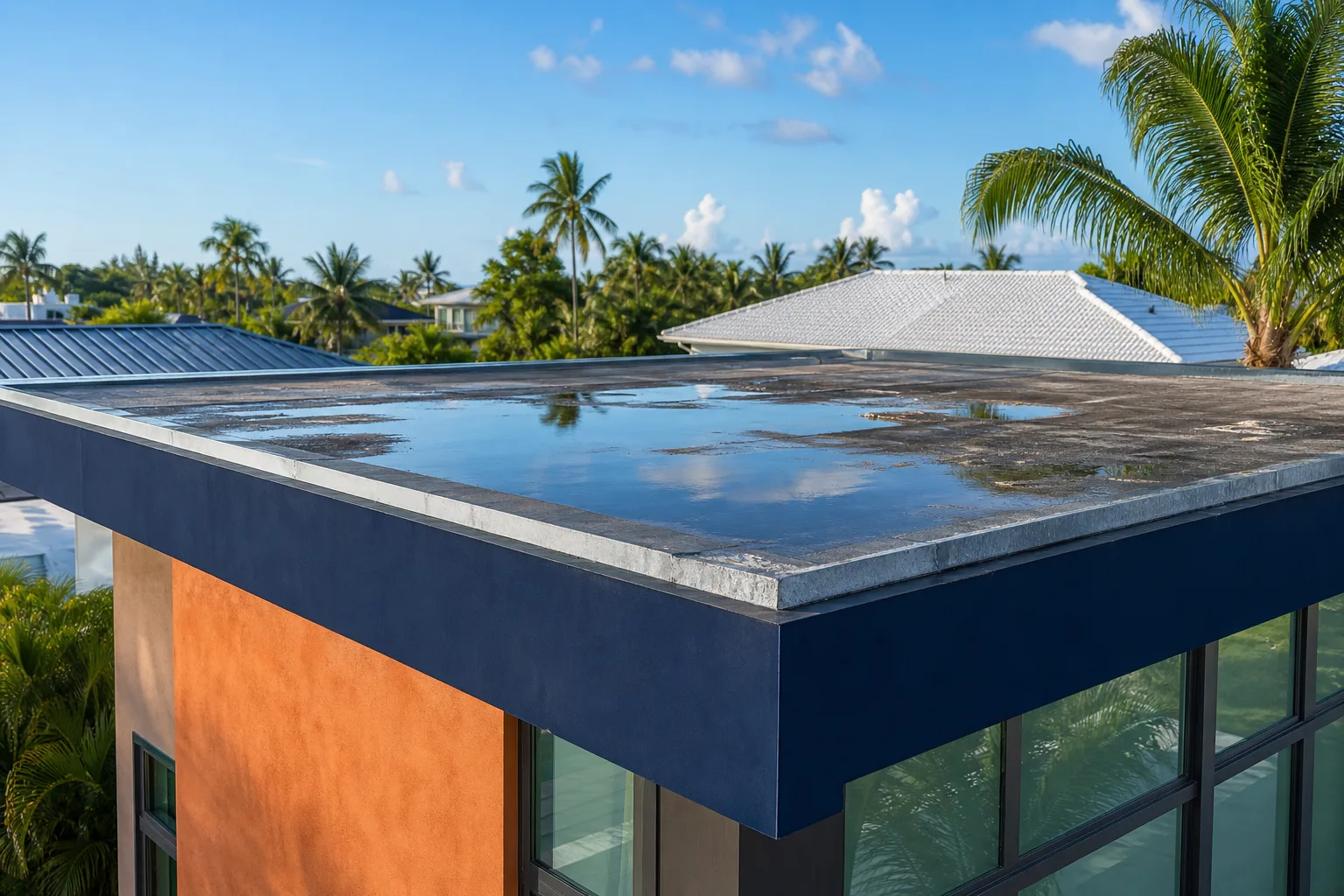
Flat roofs are not actually flat. They are designed with a slight slope, usually a quarter inch of rise per foot, to move water toward drains or scuppers. When that slope is wrong from the start, or when drains get clogged, water ponds. Standing water is the single biggest killer of flat roofing systems in South Florida.
Here is what happens: ponding water adds weight, softens membrane seams, and creates a perfect environment for algae and root intrusion. In our climate, that process moves faster than it would in a drier region. A roof in Phoenix might tolerate a slow drain for a season. A roof in Boca Raton or Boynton Beach may start showing blister damage within months.
Beyond drainage, UV degradation is a constant threat. Modified bitumen, TPO, and EPDM membranes all break down under South Florida's sun. The top layer oxidizes, becomes brittle, and eventually cracks. Seams and flashings, which are always the weakest points, go first.
The third culprit is thermal expansion. Flat roofs heat up dramatically during the day and cool at night. That daily cycle stresses every seam, every fastener, and every penetration point. Over time, those micro-movements open gaps.
For a broader picture of how South Florida conditions affect all roof types, the commercial roofing page covers what local property managers need to know.
Step 2: Learn the Warning Signs Before They Become Emergencies
Most flat roof failures give you signals well before the ceiling starts dripping. You have to know what to look for.
On the roof surface:
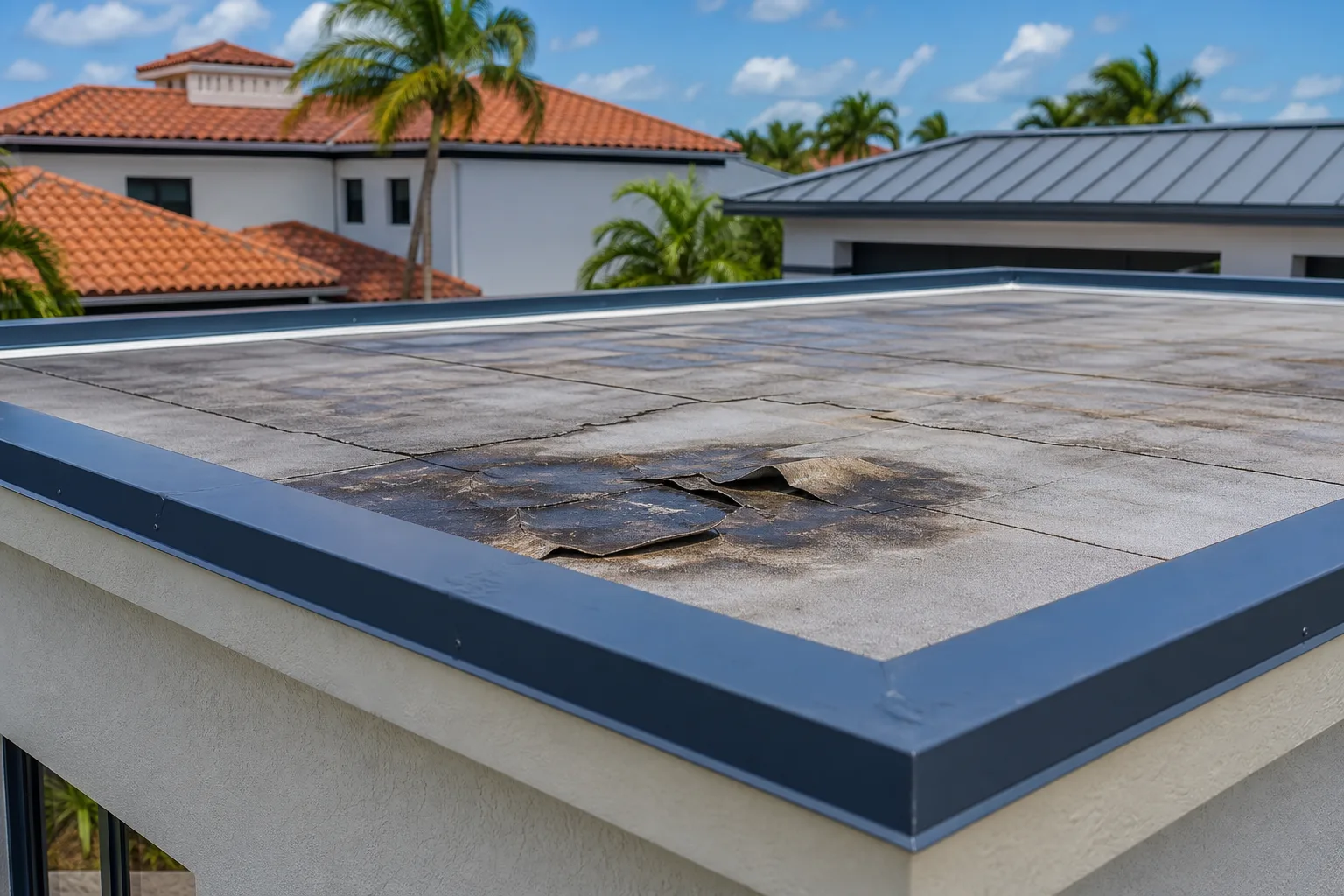
- Blistering or bubbling in the membrane, which means moisture or air is trapped underneath
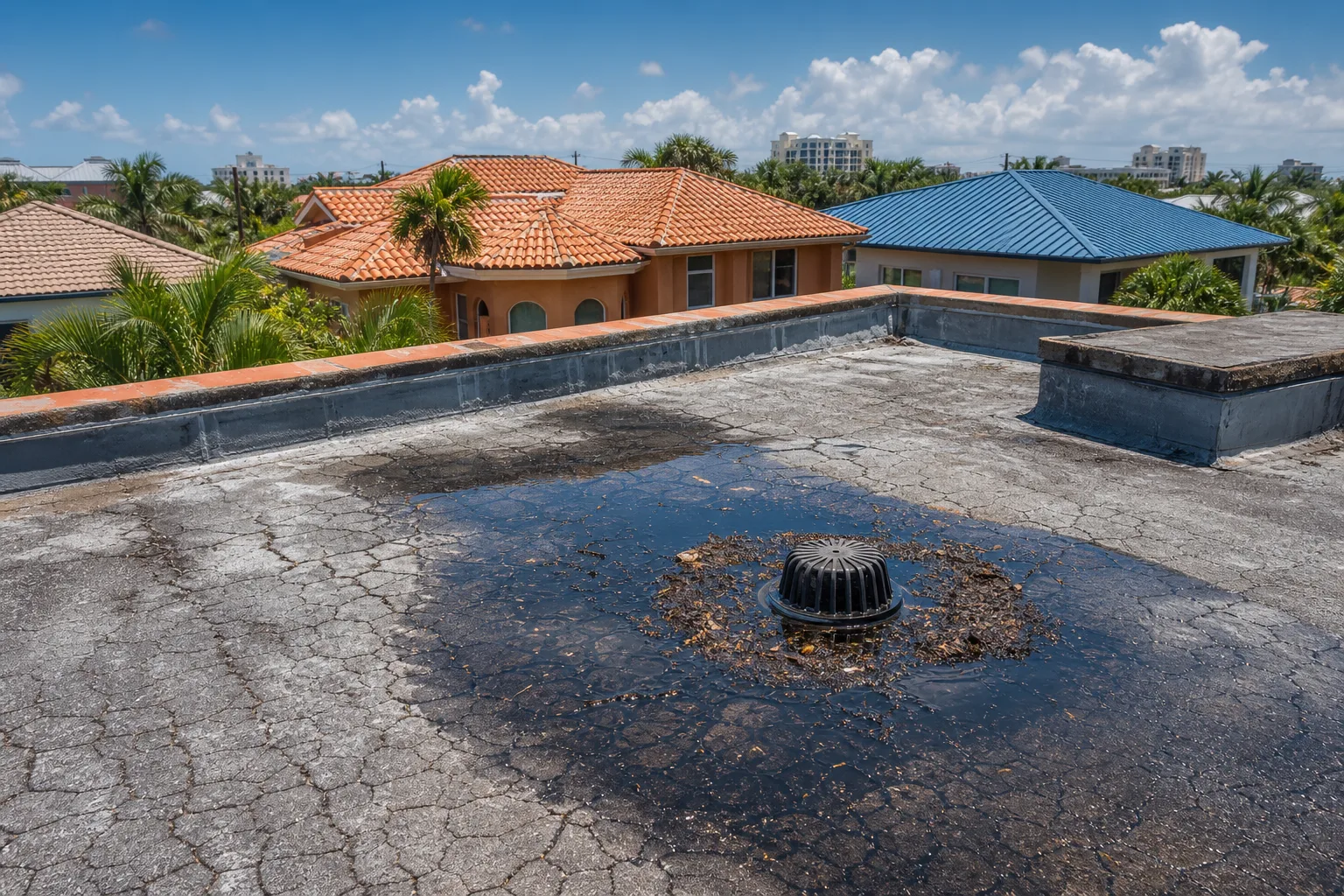
- Alligatoring, a pattern of cracked, scaly surface that looks like reptile skin, which signals UV breakdown
- Visible seam separation, especially at edges and around penetrations like HVAC units and vents
- Pooled water that remains 48 hours after a rain event
- Soft or spongy spots underfoot, which usually mean the deck below is saturated
On the interior:
- Water stains on ceilings or upper walls
- A musty smell in the building, even when nothing looks wet
- Peeling paint near roofline transitions
If you notice any of these signs, the right move is not to wait for your next scheduled inspection. The article on why roofs leak without heavy rain explains how small entry points can hide for a long time before revealing themselves inside.
Step 3: Check and Clear Your Drainage System
This is the most actionable thing a property owner or manager can do on a recurring basis. Flat roof drains and scuppers clog with leaves, debris, and sometimes bird nesting material faster than most people expect, especially heading into hurricane season.
Clean roof drains at minimum twice a year. In South Florida, the right windows are late spring before the rainy season starts, usually May, and again in November after hurricane season ends. If you have large trees near the building, quarterly cleaning is not excessive.
When you clean the drains, check the strainers for rust or damage and confirm water actually flows through freely. Run a hose into the drain if you can. If water backs up or moves slowly, the problem may be in the drain body or the interior piping, not just the strainer.
Scuppers on parapet walls need the same attention. They are often overlooked because they sit at the roof edge and are easy to miss during a quick walkthrough.
Protecting a commercial property? Request a commercial assessment
Step 4: Inspect and Maintain Flashings and Penetrations
If drainage is the top killer of flat roofs, failing flashings and penetration seals are a very close second. Every pipe, conduit, HVAC unit, and skylight that passes through your flat roof is a potential entry point for water.
Flashings are the metal or membrane material that seals the transition between your roof surface and a vertical element, like a parapet wall or an equipment curb. They flex under thermal movement, and they deteriorate faster than the field membrane because they are at corners and edges where stress concentrates.
During your inspection, press gently on the edge of flashings. Any lift or separation needs attention. Check caulking and sealant around penetrations. If it looks chalky, cracked, or has pulled away from the surface, it is no longer doing its job.
For commercial properties with multiple HVAC units, this is especially important. Contractors sometimes set new equipment on an old roof without re-flashing the curb properly. That creates an immediate vulnerability.
Our roof repairs team handles flashing work regularly and can identify whether a repair will hold or whether the underlying issue is bigger.
Step 5: Schedule Professional Inspections on a Set Calendar
Visual inspections from ground level or from standing on the roof yourself have real limits. A professional inspection goes further, including checking moisture levels in the deck with a non-destructive scan in some cases, evaluating membrane adhesion, and reviewing drainage calculations against current conditions.
For most commercial flat roofs in South Florida, a professional inspection once a year is a minimum. If your building is older than 10 years, or if you have had repairs in the past 24 months, twice a year makes more sense.
Time those inspections strategically. Late April or early May puts you in a position to address anything found before the rainy season begins. If a problem needs a repair, you want that work done before the first heavy storms arrive, not during them. The Hurricane Storm Center has additional guidance on seasonal prep timelines for South Florida property owners.
You can also start with a free instant estimate if you already suspect a problem and want to know the scope before committing to a full inspection.
Step 6: Address Small Problems Before They Compound
Flat roof repairs are almost always cheaper when caught early. A small blister repaired now costs a fraction of what it costs after that blister has allowed moisture to migrate under 200 square feet of membrane.
The rule of thumb used by experienced contractors: if you can see daylight through a seam or feel softness in the deck, you are already behind. The goal is to catch problems when they are still at the surface.
When you get a repair done, ask the contractor to document the area with photos before and after. That documentation becomes valuable if you ever file an insurance claim or need to demonstrate maintenance history during a home or building sale.
For South Florida flat roofs specifically, repair materials and methods need to match the existing system. You cannot always apply modified bitumen patch over a TPO membrane and expect it to hold. Make sure whoever does the work understands the original system. Flat roof options for commercial buildings explains the differences between systems if you need to get oriented.
Common Mistakes Property Owners Make With Flat Roofs
Waiting for a visible leak. By the time water is dripping inside, the damage is already significant. The roof surface failed weeks or months earlier.
DIY patching with the wrong materials. Hardware store sealants are not rated for continuous UV exposure and standing water. They may stop a drip for one season and make a proper repair harder later.
Ignoring drainage after a roof replacement. A new membrane installed over poor slope or blocked drains will fail on the same timeline as the old one. The system has to work together.
Letting HVAC contractors work on the roof without involving a roofer. Equipment installation and servicing can inadvertently damage membranes, pull up flashings, or leave penetrations unsealed. A simple walkthrough after any rooftop mechanical work can catch problems before they become repairs.
Skipping inspections because nothing looks wrong. Flat roof deterioration is often invisible from street level and even from standing on the surface. Thermal scans and probing are the only way to know what is happening underneath.
Bottom Line
Flat roofs in South Florida do not have to fail early. The ones that do usually fall short in the same ways: drainage neglected, flashings ignored, repairs deferred, or installation that cut corners on slope and seam work.
Stay on a maintenance calendar, keep drains clear, and get eyes on the roof professionally at least once a year. When something looks off, address it before the rainy season puts it to the test.
If your flat roof is showing any of the signs covered here, or if you just want a baseline on where things stand, the commercial roofing team at Millennium Makeover can walk you through what they find and what it actually means. You can also request a quote directly if you already know work needs to be done.
Protecting a commercial property?
We handle flat, tile, and metal commercial roofs across Palm Beach County with minimal disruption to your operation.
Request a commercial assessment
Frequently asked questions
How long should a flat roof last in South Florida?
A well-installed flat roof with regular maintenance typically lasts 15 to 25 years depending on the system, whether TPO, modified bitumen, or EPDM. South Florida's UV intensity and storm exposure can shorten that range if maintenance is skipped. Proper drainage and annual inspections are the biggest factors in reaching the upper end of the lifespan.
What causes ponding water on a flat roof?
Ponding water usually comes from inadequate slope, clogged drains or scuppers, or a deck that has deflected over time and created low spots. In South Florida, debris buildup from storms can block drains quickly. Any standing water that remains 48 hours after rain should be investigated by a licensed roofer.
Can I walk on my flat roof to inspect it myself?
You can do a basic visual inspection from the roof surface, but use caution near soft or spongy areas since those may indicate a compromised deck beneath. Wear soft-soled shoes to avoid adding puncture damage to an already stressed membrane. For anything beyond a surface look, a professional with moisture detection equipment will find problems you cannot see by eye.
How often should flat roofs be professionally inspected in Florida?
Once a year is the minimum for most flat roofs, ideally in late April or early May before the rainy season begins. Buildings older than 10 years or those with a history of repairs benefit from twice-yearly inspections. Timing inspections before hurricane season gives you time to make repairs before storms put the roof under stress.
Is it worth repairing a flat roof or should I just replace it?
It depends on the age, the extent of membrane damage, and the condition of the deck underneath. Repairs make good financial sense when the damage is isolated and the rest of the membrane is still adhered and intact. If moisture has spread under a large portion of the surface or the deck is rotting, replacement is usually more cost-effective over a five-year horizon than repeated patching.