Roof Blistering in South Florida: Causes and Fixes
In this article
TL;DR: Roof blistering happens when trapped moisture or air under the roofing material expands from heat, pushing up bubbles in shingles, membranes, or coatings. In South Florida, our combination of intense sun, humidity, and afternoon heat cycles makes it worse than almost anywhere else in the country. Small blisters can often be monitored or spot-repaired, but widespread blistering usually points to a moisture or ventilation problem underneath that needs a real inspection.
I get calls about this every summer. Homeowner walks the yard, looks up, and notices little bumps or bubbles on the shingles or flat roof membrane that weren't there last year. Sometimes it's one or two spots. Sometimes the whole south-facing slope looks like it has chicken pox. Either way, it's worth understanding what's actually happening before you panic or ignore it.
What you need
Before you climb up or call someone out, here's what helps you have a useful conversation about blistering:
- Binoculars or a zoom lens to look at the roof from the ground first
- Knowledge of your roof's age and material (shingle, tile, metal, or flat/low-slope membrane)
- Any past repair or re-roof records, especially if a recoat or overlay was done
- A notepad to track which parts of the roof face south or west, since that's usually where blistering shows up first
- A willingness to get a licensed inspection rather than guessing, because blistering can look similar whether the cause is minor or serious
If you're not sure where to start, our free instant estimate tool gives you a baseline, and a full roof repair inspection can tell you what's actually going on underneath.
Step 1: Understand what blistering actually is
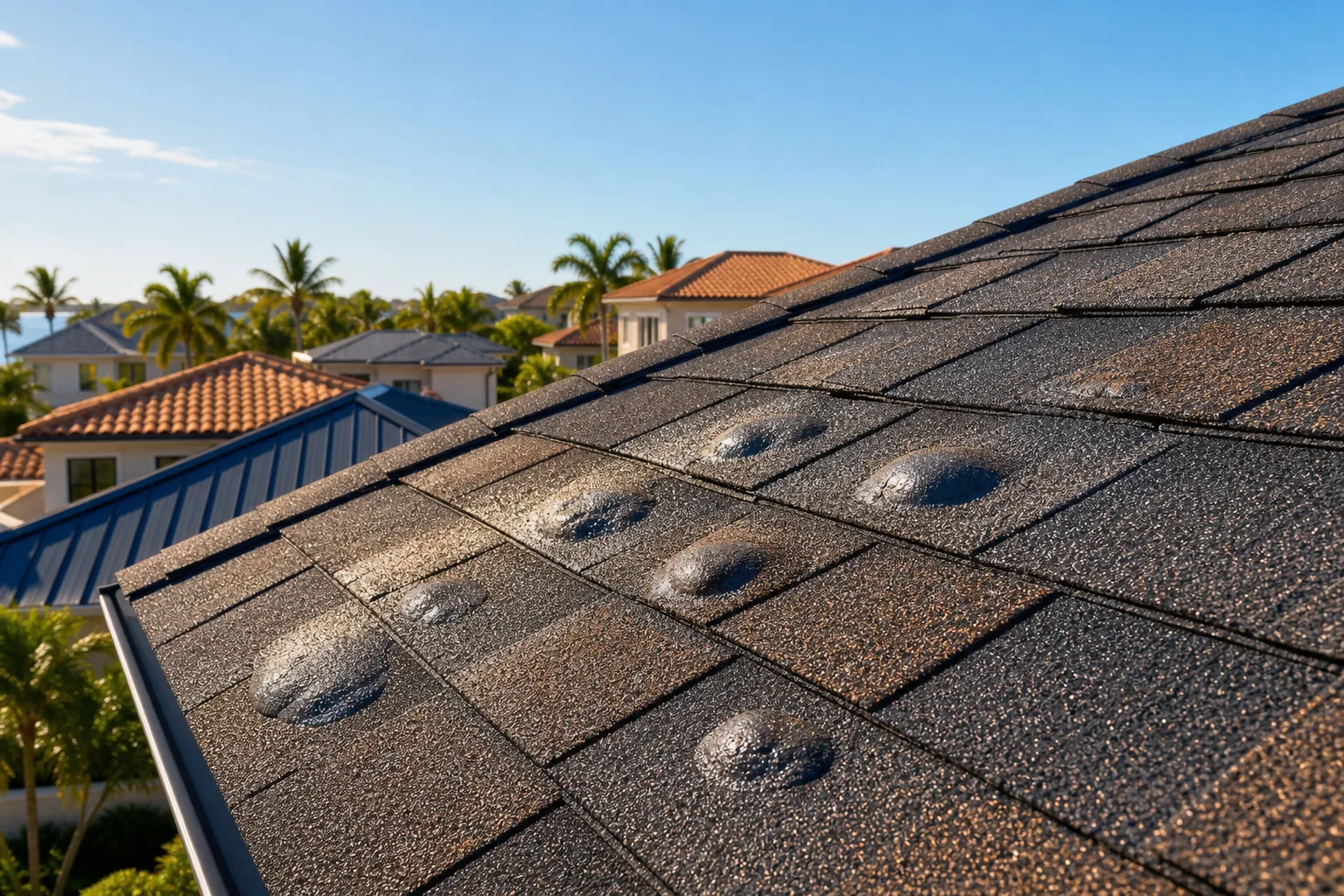
A blister forms when there's a pocket of trapped air or moisture between layers of roofing material. On shingles, that's usually between the fiberglass mat and the asphalt coating, or between the shingle and the underlayment. On flat and low-slope membrane roofs, it's often trapped moisture between the membrane and the substrate, or air pockets from an incomplete adhesive bond during installation.
Here's the mechanism. South Florida roofs regularly hit surface temperatures well above 150 degrees Fahrenheit on a sunny afternoon. Trapped moisture or air under that surface heats up and expands. Asphalt and membrane materials get soft in that heat, so the expanding pocket pushes the surface upward instead of just building pressure. When the roof cools at night, the material hardens again with that bubble frozen in place. Do that enough times across enough summers, and the blister eventually cracks or splits at the top, exposing the layer underneath to water.
Step 2: Figure out where the moisture is coming from
This is the part homeowners usually skip, and it's the most important step. Blistering itself is a symptom. The real question is why there's moisture or trapped air under the surface in the first place. In my experience inspecting roofs across Boynton Beach, Delray Beach, and Boca Raton, it usually comes down to one of these:
Manufacturing or installation issues. Sometimes a shingle or membrane sheet traps a small amount of air or moisture during manufacturing, or an installer doesn't get full adhesive contact during a hot-applied or self-adhered install. These blisters tend to show up early, sometimes within the first year or two.
Attic or deck moisture pushing outward. If there's poor attic ventilation, humid air trapped under the roof deck can migrate upward and get trapped under the shingles from below. This is common in older South Florida homes where ridge and soffit vents were never properly balanced.
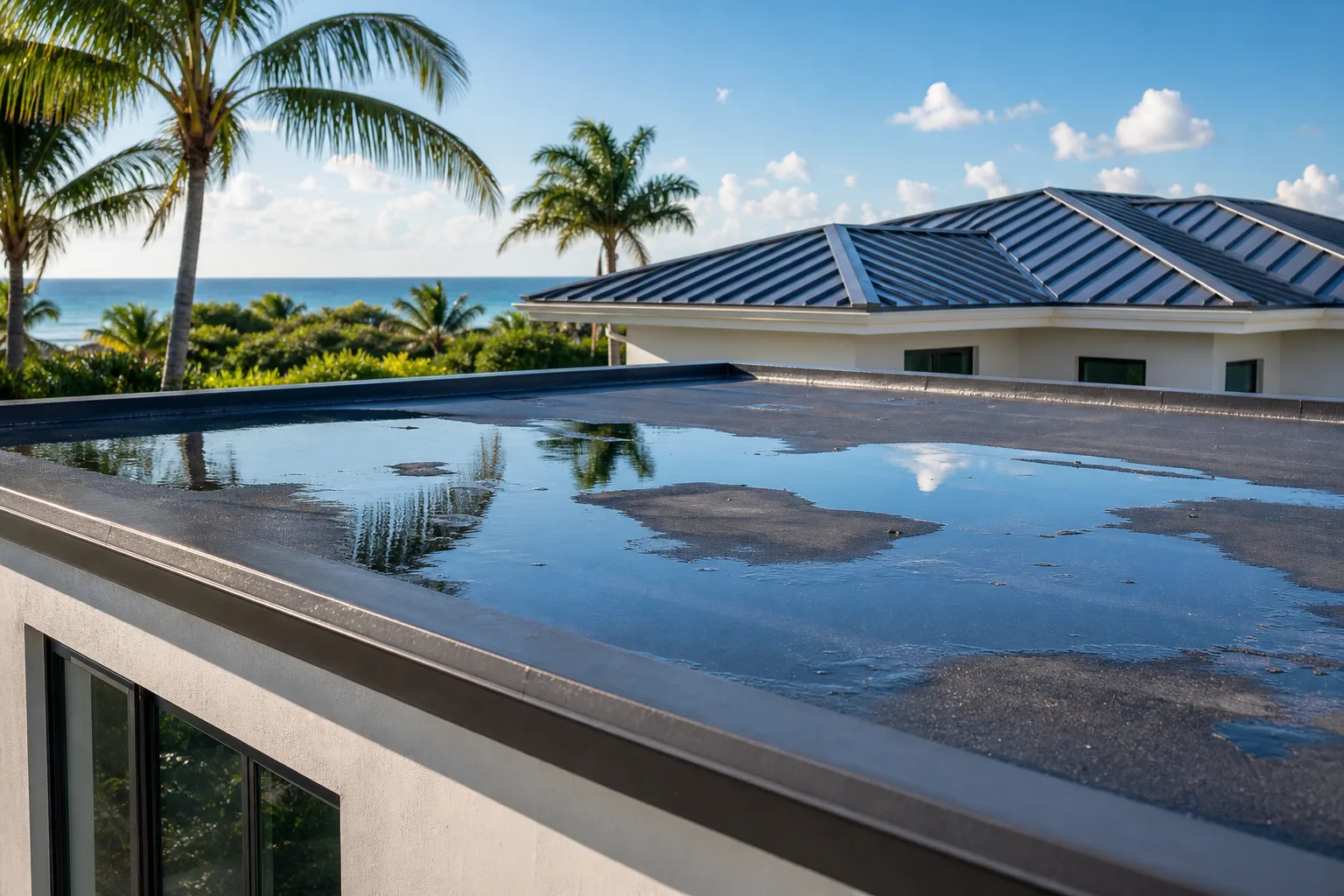
Ponding or slow drainage on flat roofs. Commercial and flat residential roofs that don't drain well hold moisture against the membrane longer, increasing the odds of blistering at low points. If you manage a commercial property, this is worth flagging during a commercial roofing inspection since ponding issues tend to get worse, not better.
Age and UV breakdown. As asphalt and membrane materials age, the bonding agents that hold layers together degrade from years of UV exposure. Older roofs blister more easily simply because the material has less flexibility and adhesion left.
Spotted a leak or missing tiles? Schedule a repair visit
Step 3: Inspect the severity, not just the appearance
When I'm called out for blistering, I'm not just counting bubbles. I'm checking a few specific things:
Size and density. A handful of small blisters, each under an inch, scattered on a south-facing slope is common and often cosmetic. Dense clusters, or blisters larger than a couple inches, are a different story.
Whether they've cracked open. I press on blisters carefully and look for any that have split at the top. A cracked blister is no longer a heat-and-air issue, it's an open door for water. Those get addressed immediately, not monitored.
Location relative to roof penetrations and valleys. Blistering near vents, chimneys, or valleys gets extra scrutiny because those areas already have more complex flashing work, and moisture intrusion there compounds fast. This connects closely to how roof flashing performs over time.
Underlayment and deck condition where accessible. On a shingle roof, if I can safely lift an area near a blister cluster, I want to see whether the underlayment below shows staining or softness. On a flat roof, I'll check for soft spots by walking a grid pattern, since a spongy feel under a blistered area usually means moisture has already reached the insulation board.
Attic conditions. I'll check attic temperature and humidity, look at insulation for moisture staining, and confirm intake and exhaust ventilation are actually balanced, not just present.
Step 4: Match the fix to what you actually find
Not every blister needs the same response. Here's how I generally sort it out:
Isolated, unopened blisters on a shingle roof that's otherwise in good shape. These can often be left alone and monitored, or the affected shingles replaced individually if you want to be proactive. This is a straightforward job under shingle roofing repair work.
Cracked or split blisters, anywhere. These need repair now. Water is getting past the surface layer, and on a shingle roof that means it's sitting on the underlayment, which was never designed to handle prolonged exposure.
Widespread blistering tied to attic ventilation problems. The blistering is a symptom here, not the disease. Fixing ventilation, adding or rebalancing intake and exhaust vents, matters more than patching individual blisters that will keep reappearing.
Membrane blistering on a flat or low-slope roof with confirmed moisture underneath. Depending on how much of the insulation board is saturated, this can range from a localized cut-and-patch repair to a larger section replacement. A moisture scan, sometimes infrared, sometimes a core sample, tells you how far it's spread before you commit to a repair scope.
Blistering on a roof already near the end of its expected lifespan. If the roof is old enough that blistering is showing up alongside granule loss, brittleness, or multiple other wear signs, patching blisters is often just delaying the inevitable. That's a conversation worth having honestly, and it's covered in more depth in our guide to roof replacement in Florida.
Step 5: Get bids that actually address the cause
If you're collecting quotes for blister repair, here's what separates a real bid from a rushed one. A contractor should tell you where they think the moisture or air is coming from, not just quote a price to patch what's visible. Ask specifically: did they check attic ventilation? Did they check for soft decking near the blisters? Did they mention anything about the underlayment or membrane adhesion? If one bid is dramatically cheaper and just says
Spotted a leak or missing tiles?
Small problems get expensive fast in the Florida sun. Get it looked at by a local crew before the next storm.
Frequently asked questions
Is roof blistering dangerous?
Not immediately, but it's a warning sign. Small unopened blisters are usually cosmetic, while cracked blisters expose the layers underneath to water intrusion, which can lead to deck damage or leaks if left unaddressed.
Can I just pop or cut off a blister myself?
We'd advise against it. Cutting into a blister without knowing what's trapped underneath can create a new entry point for water, and walking on a roof without experience carries its own risks. It's better to have it evaluated first.
Does blistering mean I need a full roof replacement?
Not necessarily. Isolated blistering on an otherwise healthy roof is often a targeted repair. Widespread blistering combined with other age-related wear, like granule loss or brittle materials, is more likely to point toward replacement being the smarter long-term option.
Why does blistering seem worse on the south or west side of my roof?
Those sides get the most direct sun exposure through South Florida afternoons, so they experience the highest surface temperatures and the most heat cycling, which is the main driver of blister formation.
How do I know if it's blistering or algae staining?
Blisters are raised, three-dimensional bumps you can usually feel or see a shadow around, while algae staining is flat, dark streaking on the surface. If you're unsure which one you're looking at, a visual inspection can confirm it quickly.