Standing Water on a Flat Roof: What Happens Day by Day
In this article
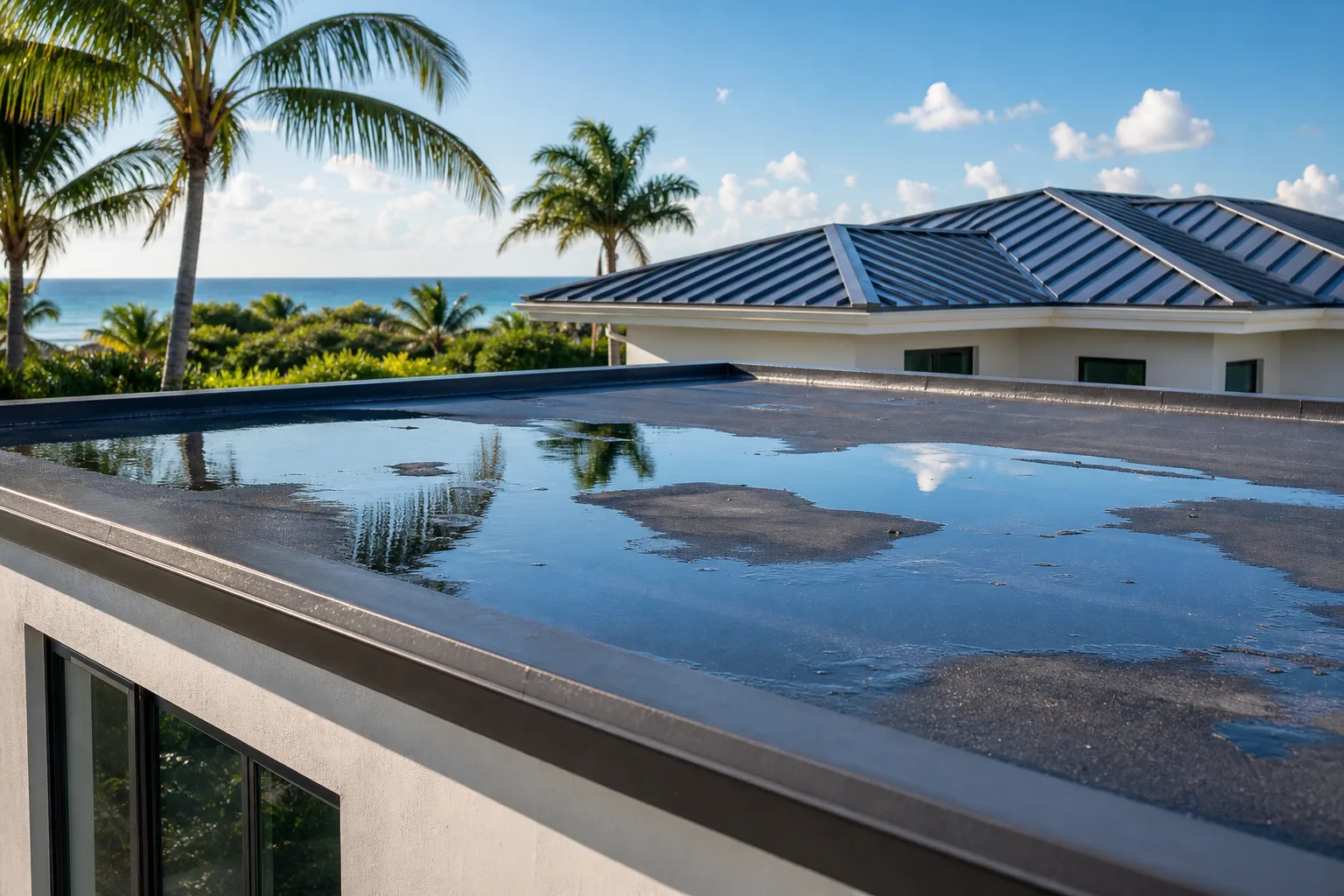
TL;DR: A little standing water after a hard rain on a flat roof is normal and usually drains within a day. Water that sits for 48 hours or longer starts breaking down the membrane, feeding algae and UV damage, and adding weight the deck wasn't built to hold indefinitely. I check ponding depth, drainage slope, and membrane condition every time I'm on a flat roof, and I'll walk you through exactly what I'm looking at.
I get called out to a lot of flat roofs in Boynton Beach and Delray Beach where the owner says something like "there's a puddle back there, is that bad?" Sometimes it's nothing. Sometimes it's the reason the ceiling tile three rooms away is stained. The difference usually comes down to how long the water sits and what the roof surface looks like underneath it.
What you need
You don't need much to check this yourself between professional inspections:
- A dry day, at least 48 hours after the last rain
- A ladder or safe roof access (or binoculars if you're not comfortable going up)
- A flashlight for looking under any accessible eaves or in the attic below the flat section
- A phone camera to document what you see and track changes over time
- Basic knowledge of where your roof drains, scuppers, or gutters are located
If you're not sure any of this is safe to check yourself, that's exactly what an inspection is for. I'd rather walk your roof myself than have someone slip trying to look at a puddle.
Step 1: Understand why flat roofs pond in the first place
No flat roof is perfectly flat. Every properly built one has some slope, usually a very slight one, engineered to move water toward drains, scuppers, or gutters. Ponding happens when that slope isn't enough, or when something is blocking the path water is supposed to take.
Common causes I find during inspections:
- Low spots from an aging or slightly sunken roof deck
- Clogged or undersized drains
- Debris (leaves, sand, roofing granules) built up in low areas
- A roof that was never sloped correctly during a past installation
- Structural settling that changed the roof's original pitch over the years
A small amount of water sitting for a few hours after a storm is normal, even on a well-built roof. It's the water that's still there two or three days later that tells me something's off.
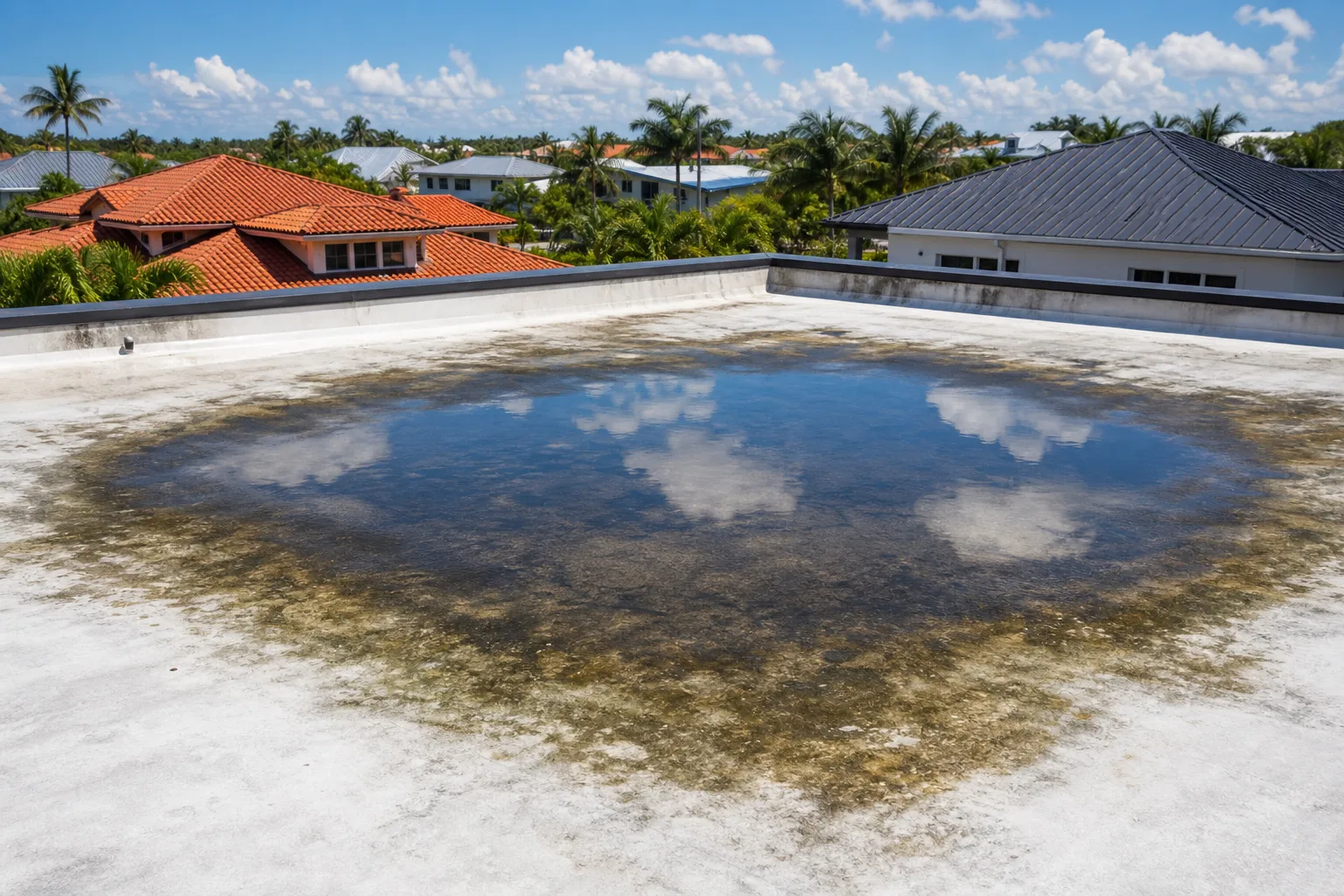
Step 2: Know the 48-hour rule inspectors actually use
Most roofing codes and manufacturer warranties reference a standard: if water is still standing 48 hours after rainfall with no additional precipitation, that's considered ponding water, and it's treated as a defect, not just a cosmetic issue.
This isn't an arbitrary number. It's roughly the point where:
- UV degradation of the membrane accelerates in the ponded area, because standing water acts almost like a magnifying layer under Florida sun
- Algae, mold, and organic growth start to establish themselves
- The membrane, especially at seams, begins absorbing moisture instead of just repelling it
- Structural load starts to matter, since water weighs about 8.3 pounds per gallon and it adds up fast across a low spot
If you check your roof and water's still sitting past that 48-hour mark on a regular basis after normal storms, that's a pattern worth having looked at, not a one-time fluke.
Step 3: Look at what standing water actually does to the membrane
Here's what I'm checking when I see a ponding area on a modified bitumen, TPO, or built-up roof:
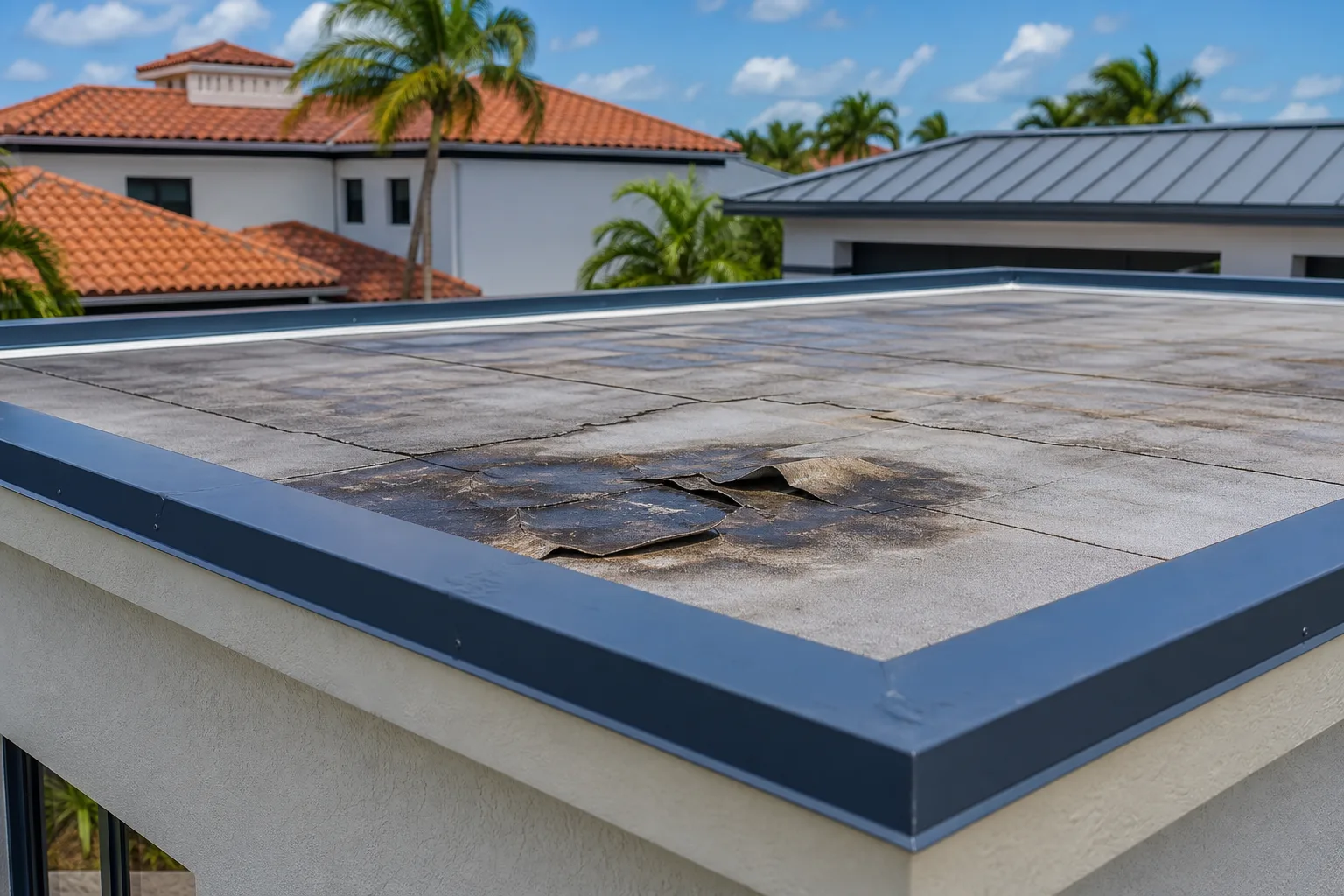
Seam integrity. Seams are the weakest point on most flat roof membranes. Standing water finds them, works into them, and over time can lift or separate the seal. I press on seams near ponding areas and look for sponginess or bubbling.
Surface granule loss. On mineral-surfaced cap sheets, I look for bare, shiny patches where granules have washed away or worn off under standing water. Once the granules are gone, UV rays hit the asphalt underneath directly, and that speeds up cracking.
Blistering and bubbling. Trapped moisture under the membrane can cause raised bubbles, especially as the sun heats the water and creates vapor pressure underneath. These often show up right at the edge of a ponding zone.
Discoloration. Dark staining, algae streaks, or a slightly different sheen in the ponded area versus the rest of the roof tells me water has been sitting there repeatedly, not just once.
If you want a deeper look at how staining patterns tell different stories on a roof, that's worth its own conversation, but for flat roofs specifically, ponding-related staining tends to follow the exact shape of the low spot, which is a pretty reliable tell.
Spotted a leak or missing tiles? Schedule a repair visit
Step 4: Check what's happening below the surface
Membrane damage is only half the story. Standing water that's been sitting for days is also working on what's underneath:
- Insulation boards under the membrane can absorb moisture through even tiny membrane failures, and wet insulation loses R-value and can't dry out on its own once it's saturated
- The roof deck itself, usually plywood or a structural panel, can start to soften or delaminate if water keeps finding its way in over months or years
- Interior ceilings below flat roof sections often show the first visible sign, a yellow-brown stain or soft spot in the drywall, well before anyone notices the ponding above
This is why I always recommend pairing a rooftop check with a quick look at ceilings directly below any known low spots, especially in commercial buildings with large flat roof sections. If you're dealing with an active leak already, roof repairs can often address a specific failure point without requiring you to redo the whole membrane, but that depends on how far the damage has spread.
Step 5: Measure the depth and track how long it sits
If you're checking this yourself, here's a simple way to get real data instead of guessing:
- After a rain, note the time and check the roof.
- Use a ruler or stick to measure water depth at the deepest point.
- Check again at 24 hours, 48 hours, and 72 hours if it's still there.
- Take a photo each time from the same spot so you can compare.
- Write down whether the puddle is shrinking, staying the same size, or growing.
A puddle that's noticeably smaller at 24 hours and gone by 48 is probably within normal range for a low-slope roof. A puddle that looks basically the same size at 72 hours as it did at 24 is a drainage problem, not a drying problem, and it's going to keep happening every time it rains, which in South Florida is often.
Step 6: Decide whether it's a drainage fix or a roof problem
Once you know you've got a real ponding issue, the fix depends on the cause:
If it's debris blocking a drain, that's usually a maintenance fix. Cleared drains and scuppers, maybe a strainer added to keep leaves out, and you're done. This is also a good time to check your gutters if the flat section drains into a gutter system, since a clogged gutter downstream can back water up onto the roof itself.
If it's a shallow low spot from minor settling, sometimes tapered insulation can be added during a re-cover to build up slope in that specific area, redirecting water toward the existing drains without a full tear-off.
If it's a structural or design issue, meaning the roof was never sloped enough to begin with, or the deck has settled significantly, that's a bigger conversation about whether a section needs to be rebuilt or the whole roof needs new tapered insulation as part of a full roof replacement or commercial roofing project.
I won't tell a homeowner or property manager they need a full replacement over one puddle. But if the membrane's already showing UV damage, blistering, or seam separation in the ponding zone, patching that one spot without addressing why water collects there in the first place usually means you're back out here in a year or two.
Common mistakes
Assuming any standing water is an emergency. It's not, most of the time. A few hours or even overnight after a heavy storm is completely normal on a properly sloped flat roof.
Waiting years to address a known low spot. I've seen roofs where the same corner ponds every single storm for years, and by the time someone calls me, the deck underneath is soft. Catching it early is a lot cheaper than catching it late.
Painting over the symptom. Reflective roof coatings can help with UV protection, but they don't fix a drainage problem. If the slope is wrong, a coating just delays the conversation, it doesn't end it.
Ignoring interior signs because "the roof looks fine." Sometimes the membrane still looks okay from a quick glance, but there's already moisture working its way into the insulation or deck. A ceiling stain below a flat roof section is worth investigating even if the roof surface looks clean.
Comparing bids without comparing the actual fix. If you're getting quotes to address a ponding issue, make sure each bid explains what's actually being done, drain clearing, tapered insulation, membrane replacement, or a full tear-off, and not just a price. Two bids at very different prices might be solving two completely different problems.
Bottom line
Standing water on a flat roof isn't automatically a crisis, but it's not something to shrug off either. The 48-hour mark is the line I use in the field: water gone within a day or two is normal, water that lingers longer is doing real damage to the membrane, the insulation, and eventually the deck underneath. If you've got a spot that ponds after every storm, get it looked at before it turns into an interior repair instead of a roof repair.
If you're not sure whether what you're seeing is normal drainage or a developing problem, I'd rather take a look now than have you deal with a surprise leak later. You can request a quote or grab a free instant estimate to get a real read on your roof's condition, and if a storm's already done damage, our Hurricane Storm Center page has more on what to check first.
Spotted a leak or missing tiles?
Small problems get expensive fast in the Florida sun. Get it looked at by a local crew before the next storm.
Frequently asked questions
How long can water sit on a flat roof before it's a problem?
Most roofing standards use 48 hours as the threshold. Water still standing after 48 hours with no new rain is considered ponding water and is treated as a defect that needs attention, not just normal drainage lag.
Does ponding water always mean I need a new roof?
No. Many ponding issues come from clogged drains or debris and can be fixed with cleaning or minor drainage corrections. A full replacement is usually only needed if the slope itself is inadequate or the membrane and deck have already been significantly damaged.
Can I put a coating on my flat roof to stop ponding?
A reflective coating can help protect the membrane from UV exposure, but it won't correct a slope or drainage problem. If water is pooling because of a low spot, a coating just delays the underlying issue rather than solving it.
What does standing water do to the roof deck underneath?
Once moisture finds its way through even a small membrane failure, it can soak into insulation and eventually soften the structural deck. This kind of damage often isn't visible from the roof surface and may show up first as a ceiling stain inside the building.
How do I know if my flat roof was built with enough slope?
If the same area ponds after nearly every rain and takes more than a couple of days to fully drain, that's a strong sign the slope is insufficient. An inspector can check the roof's drainage pattern and measure how water is (or isn't) moving toward drains or scuppers.
Should I check for ponding myself or call a professional?
Checking from the ground or a safe vantage point after a storm is fine for general awareness, but getting on the roof to measure depth and inspect membrane condition is best left to someone experienced, especially on commercial buildings with large flat sections.