What Happens to Roof Decking When Rain Gets Inside
In this article
TL;DR: Once rain gets past your shingles, tile, or metal and reaches the wood decking underneath, it doesn't just sit there. It soaks in, softens the wood, and starts a rot process that can take months or years to show up as a sagging spot or a stain on your ceiling. By the time you see it, the damage is usually bigger than it looks from below.
I've pulled up thousands of square feet of decking in South Florida over the years, and I can tell you the pattern is almost always the same. Small leak, ignored for a long time, plywood turns to something closer to wet cardboard. It's preventable, but only if you understand what's actually happening under your roof covering.
What You Need To Know First
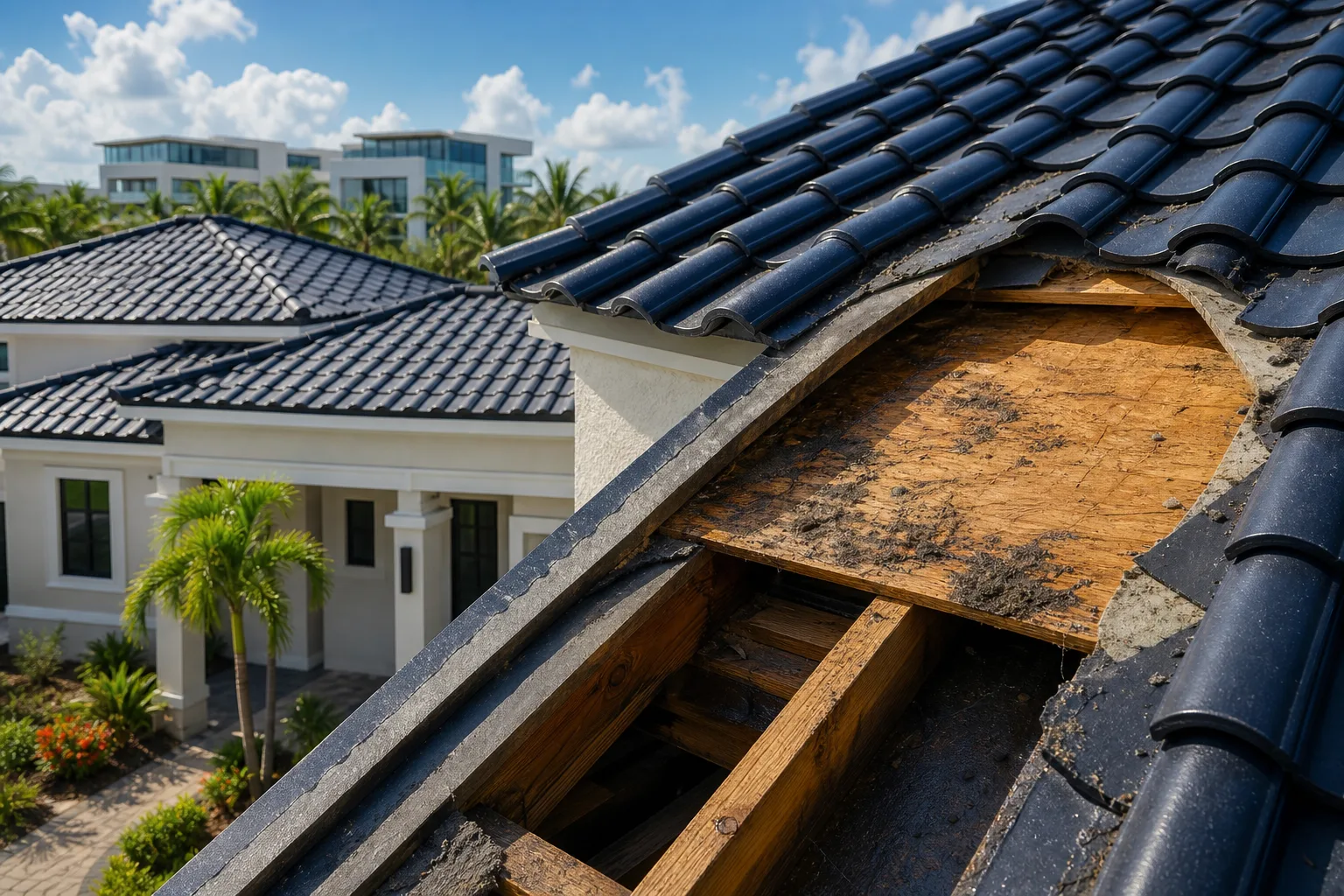
Roof decking is the plywood or OSB sheathing nailed to your roof trusses. It's the structural layer everything else sits on, your underlayment, your shingles or tile, all of it. It was never designed to get wet regularly. It's designed to stay dry, forever, protected by layers above it.
When those layers fail, even in a small spot, water finds the decking. And wood decking has one job: hold its shape and strength. Water is its enemy.
Here's what you need to understand the problem:
- Basic knowledge of your roof type (shingle, tile, or metal) and roughly how old it is
- Access to your attic with a flashlight, if you have one
- An eye for water stains, sagging, or soft spots on ceilings
- A willingness to call a roofer for an inspection instead of guessing
You don't need to be a contractor to catch this early. You just need to know where to look and what you're looking at.
One thing worth clarifying before we go further: plywood and OSB are not the same material, and they don't behave identically when wet. Plywood is made from cross-laminated wood veneers glued together, which gives it good resistance to splitting and a relatively predictable failure mode when wet. OSB, or oriented strand board, is made from compressed wood strands and resin. OSB tends to absorb water along its edges faster than through its face, which means edge swelling and delamination can happen before the center of a panel looks or feels bad. A lot of homes built in South Florida from the 1990s onward have OSB decking, so if your roof was installed or replaced in that era, it's worth knowing which material you have.
Step 1: Understand How Water Actually Gets To The Decking
In a properly built roof, water is supposed to shed off the surface layer, tile, shingle, or metal, before it ever reaches the deck. The underlayment underneath is the backup layer in case the surface fails somewhere. We've written before about why underlayment matters more in Florida than anywhere else, and this is exactly why: it's the last line of defense before water hits bare wood.
Water gets past both layers through cracked or slipped tiles, lifted or missing shingles, failed pipe boots, nail pops, damaged flashing around chimneys and walls, or just plain old age. Florida doesn't need a hurricane for this. Our regular summer rain pattern, heavy, frequent, wind-driven, is enough to find every weak point over time.
Pipe boots are one of the most common failure points we see and one of the most underestimated. A rubber pipe boot around a plumbing vent stack starts cracking from UV exposure after about ten years. Once it cracks, every heavy rain sends water straight down around the pipe and onto the decking below. Because the leak is small and centered on one penetration point, the damage often stays concentrated in a two- or three-foot radius around that stack for a long time before it spreads. By the time a homeowner notices a stain on the ceiling below, the decking around that boot has often been wet and dry dozens of times.
Flashing failures work differently. When step flashing along a dormer wall or counter flashing at a chimney separates, water doesn't always drip straight down. It can travel horizontally along the top surface of the underlayment, or wick along a rafter, and show up as a ceiling stain several feet away from where it actually entered. This is why tracing a roof leak to its source requires more than just looking directly above the stain.
Once water gets past the surface and the underlayment is compromised or worn out, it lands directly on the plywood. That's when the clock starts.
Spotted a leak or missing tiles? Schedule a repair visit
Step 2: Know What Happens To The Wood Once It's Wet
Plywood and OSB decking absorb water. They don't repel it. Once water soaks in, a few things happen in sequence.
First, the wood swells slightly and loses some of its structural stiffness. This is often invisible from above or below. A panel that looks perfectly normal from the attic floor may already have absorbed enough moisture to begin breaking down internally. You won't feel it underfoot at this stage, and you won't see any discoloration on the drywall below.
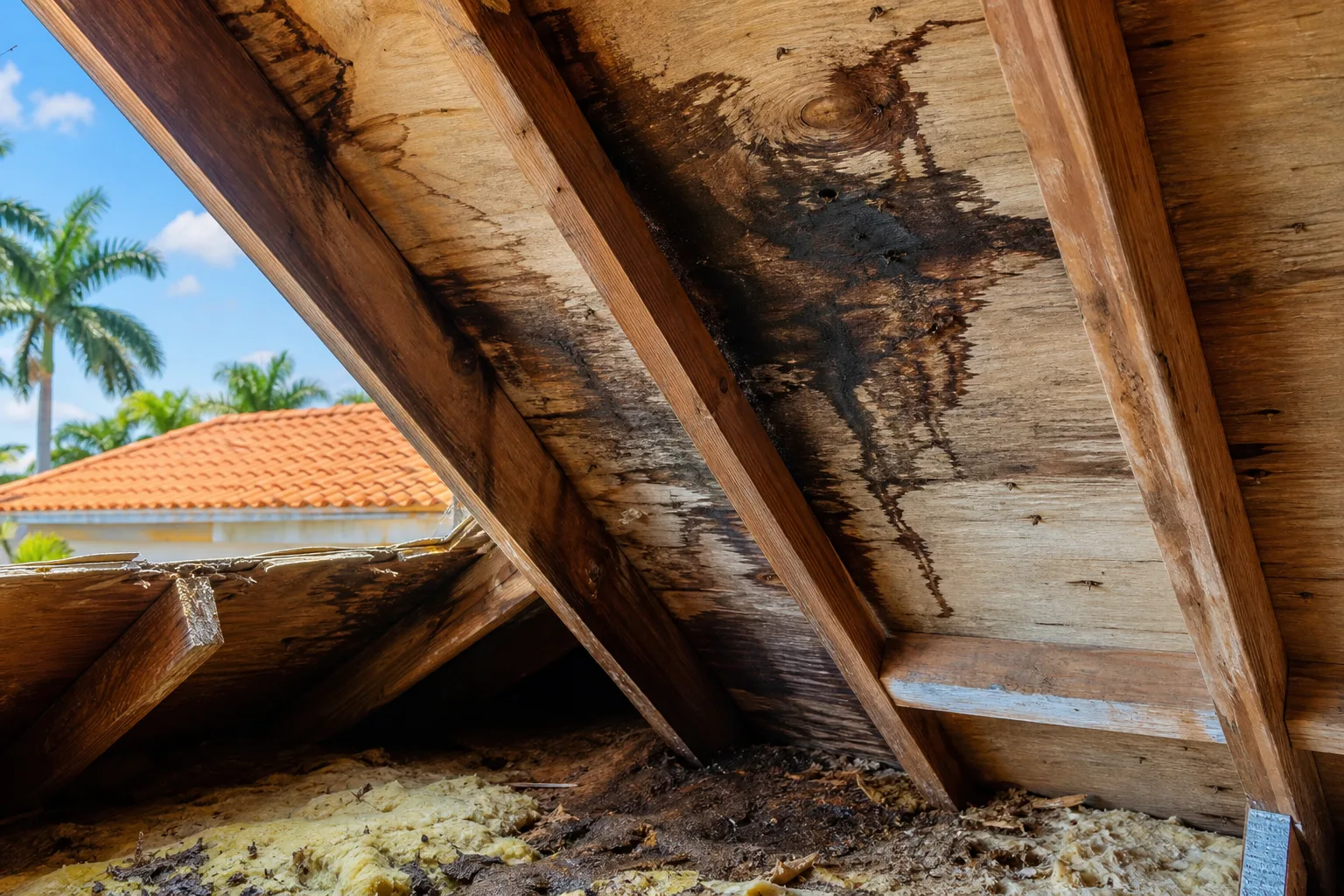
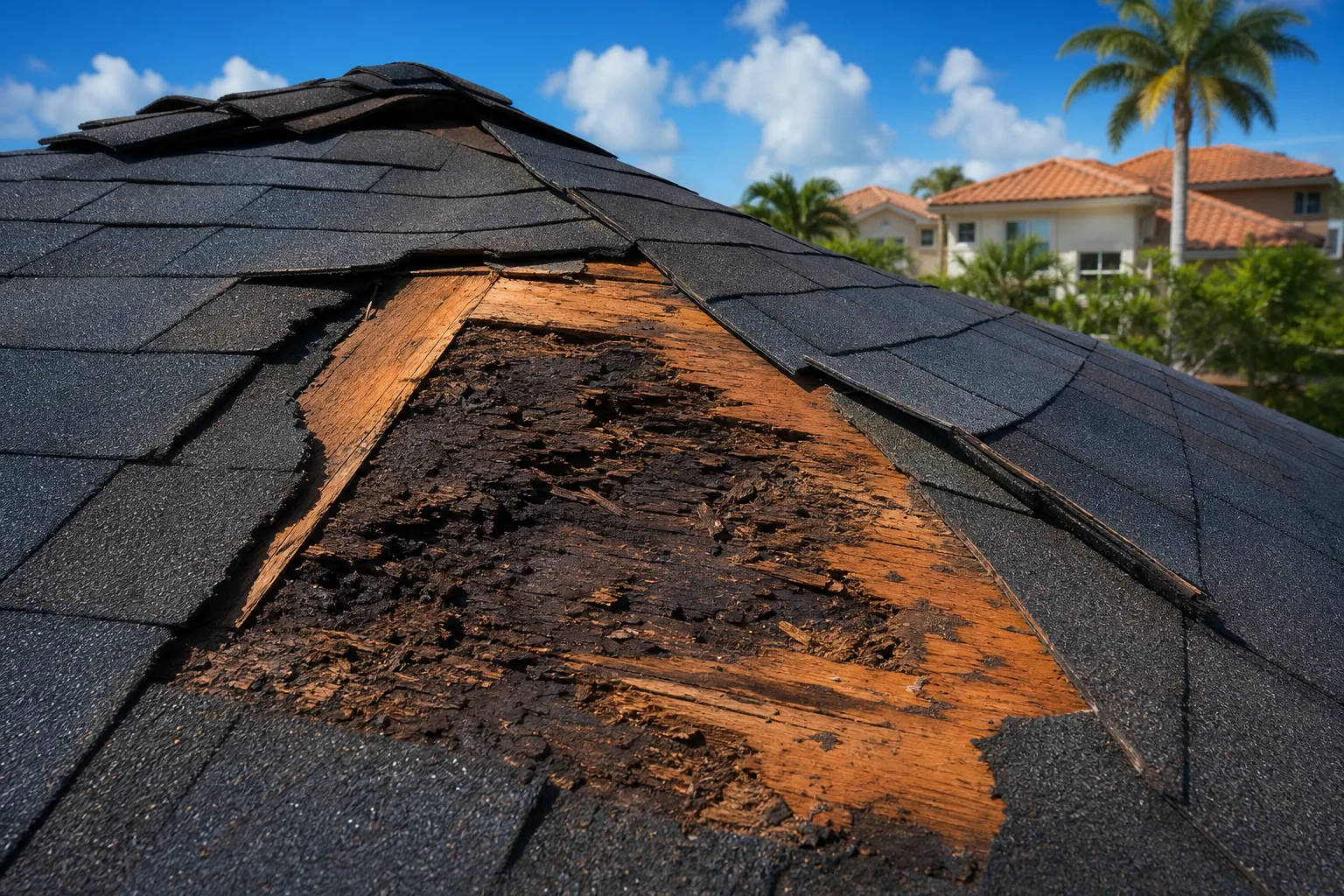
Second, if the wetting and drying cycle repeats over weeks or months, which it will because South Florida rain is frequent and relentless from June through October, the wood fibers start to break down. This is wood rot, and it's a biological process, fungi feeding on the wet wood. The two most common types that attack roof decking are brown rot and white rot. Brown rot breaks down the cellulose in the wood, leaving it dark, crumbly, and structurally hollow. White rot attacks both cellulose and lignin, leaving the wood pale and stringy. Either one will destroy the load-bearing capacity of a decking panel faster than most homeowners expect.
Third, once rot sets in, the decking loses its ability to hold nails or screws securely. This matters enormously with tile roofs, where the tile battens or the tile itself relies on solid decking underneath. A rotted deck under tile can lead to loose tile, cracked tile, or in bad cases, a section of roof that simply cannot support foot traffic anymore. We've walked roofs in Broward and Miami-Dade counties where a technician stepping in the wrong spot punched straight through the decking because the plywood underneath had rotted down to almost nothing. From the surface, the tile looked fine. The damage was entirely hidden.
Fourth, in advanced cases, you'll see visible sagging from below, a soft or spongy feel when walking the roof surface, or dark staining visible on the underside of the decking when viewed from the attic. At this point you're no longer dealing with a simple patch repair. Full or partial decking replacement becomes necessary, which means stripping the roof covering in that section, removing the damaged panels, installing new plywood or OSB, re-nailing to code, and then re-covering. In Florida, that work has to meet current wind uplift requirements, which means specific nail patterns and fastener schedules, not just slapping down a new sheet and covering it back up.
Fifth, and this is something most articles skip over entirely, compromised decking affects the performance of everything installed on top of it. A new shingle installation over soft decking won't achieve proper nail embedment, which means the shingles won't meet their rated wind resistance. In a state where wind mitigation credits on your insurance premium depend on verified nail patterns and fastener schedules, this is a real financial issue, not just a structural one. A roof that passes visual inspection but has hidden soft spots in the decking is a roof that may fail its wind mitigation inspection and cost you more on your premium than you saved by cutting corners on the repair.
Step 3: Look For Early Warning Signs Before The Damage Spreads
The best time to catch decking damage is before the rot has spread beyond the immediate leak zone. Here's where to focus your attention.
In the attic, use a strong flashlight and look for dark staining or discoloration on the underside of the decking panels. Fresh water intrusion often shows as a dark wet streak along the wood grain. Older damage shows as black or gray mold staining, sometimes with a fuzzy texture. Press gently on any discolored areas with your hand. Solid, dry wood will feel firm and unyielding. Rotted wood will flex, crumble slightly, or feel soft under light pressure. If you find either of those signs, mark the location as best you can relative to a known reference point, like a vent stack or the ridge, and call a roofer. Don't delay.
On the ceiling inside the house, water stains are obvious indicators, but pay attention to their shape and pattern. A single circular stain that has dried and left a hard ring usually means a slow, ongoing leak, not a one-time event. A large irregular stain after a single heavy storm may mean a more acute failure, like a missing shingle or a completely failed boot. Stains that reappear after you've painted over them are telling you the source has never been fixed.
On the roof surface itself, look for any tile that rocks when you press on it, any shingle that lifts at the corner, or any area where the roof surface appears to dish or sag slightly between the trusses. That subtle bowl shape is a direct sign of decking that has swollen and partially delaminated underneath.
What Repair Actually Looks Like
If a roofer identifies decking damage during an inspection or a re-roof, the repair process is straightforward but not cheap. Damaged panels get cut out back to the nearest rafter or truss on each side, so you're always fastening new wood to solid framing. Replacement panels go in, are nailed to the current Florida Building Code schedule, and then the roofing layers are rebuilt on top.
The cost varies a lot depending on how far the damage has spread. A single four-by-eight panel replacement during a re-roof might add a few hundred dollars to the job. Extensive rot across a large section of a hip roof can add thousands and extend the project timeline by a day or more. Catching it early, when it's still one or two panels rather than a dozen, is where the real savings are.
The underlying message here isn't complicated. Roof decking is designed to last the life of your roof if it stays dry. Once water finds it regularly, the degradation is biological and relentless. Small leaks become big repairs not because the damage is dramatic, but because it's invisible and slow, right up until the point it isn't.
Spotted a leak or missing tiles?
Small problems get expensive fast in the Florida sun. Get it looked at by a local crew before the next storm.
Frequently asked questions
How does rain water get past the shingles or tiles to reach the roof decking?
Water reaches the decking when surface layers fail through cracked or slipped tiles, lifted shingles, damaged flashing, nail pops, or failed pipe boots. The underlayment acts as a backup barrier, but once it is compromised or worn out, water lands directly on the plywood or OSB beneath. Florida's frequent, wind-driven summer rains are especially effective at finding these weak points over time.
What actually happens to roof decking once it gets wet?
Wet decking first swells and loses structural stiffness, often with no visible signs. Repeated wetting and drying cycles trigger wood rot, a biological process where fungi break down the wood fibers, causing the panel to become crumbly, hollow, or stringy. In advanced cases, the decking loses its ability to hold nails securely and can no longer support foot traffic or the roofing materials above it.
What is the difference between plywood and OSB decking when exposed to moisture?
Plywood is made from cross-laminated wood veneers and has a relatively predictable failure mode when wet. OSB, made from compressed wood strands and resin, absorbs water faster along its edges, meaning edge swelling and delamination can occur before the center of a panel shows any visible damage. Many South Florida homes built from the 1990s onward use OSB decking, making it important to know which material your roof has.
What are the early warning signs of roof decking damage I can look for myself?
In the attic, look for dark staining or discoloration on the underside of the decking and press on discolored areas to check for softness or crumbling. Inside the house, water stains that reappear after painting indicate an unresolved leak source. On the roof surface, tiles that rock when pressed, shingles that lift at the corner, or subtle dishing between trusses can all signal decking that has swollen or delaminated underneath.
How does damaged roof decking affect my homeowner's insurance or wind mitigation rating?
Installing new roofing over soft or rotted decking prevents proper nail embedment, meaning shingles won't achieve their rated wind resistance. In Florida, wind mitigation credits on insurance premiums depend on verified nail patterns and fastener schedules. A roof with hidden soft spots in the decking may fail a wind mitigation inspection, potentially costing more in higher premiums than was saved by skipping a thorough decking repair.
What does repairing damaged roof decking actually involve and how much does it cost?
Damaged panels are cut back to the nearest rafter or truss on each side, new panels are installed and nailed to Florida Building Code requirements, and then the roofing layers are rebuilt on top. Costs vary widely depending on the extent of damage; replacing a single panel during a re-roof may add a few hundred dollars, while extensive rot across a large section can add thousands and extend the project by a day or more. Catching damage early, when only one or two panels are affected, is where the most significant savings occur.