What Roof Fastener Patterns Mean for Hurricane Resistance
In this article
TL;DR: Fastener pattern, nail gauge, and penetration depth determine whether sheathing and shingles stay on your roof in high winds. Florida Building Code sets minimum requirements, but older roofs often miss them. Knowing what to look for can help you ask the right questions before the next storm.
What Happened
After Hurricane Andrew in 1992, engineers found that roofs failed not because of inferior materials but because fasteners were under-driven, wrong-gauge, or spaced too far apart. That finding drove major revisions to the Florida Building Code, which now mandates specific fastener schedules for roof decks and coverings in High-Velocity Hurricane Zones (HVHZ) and the rest of the state.
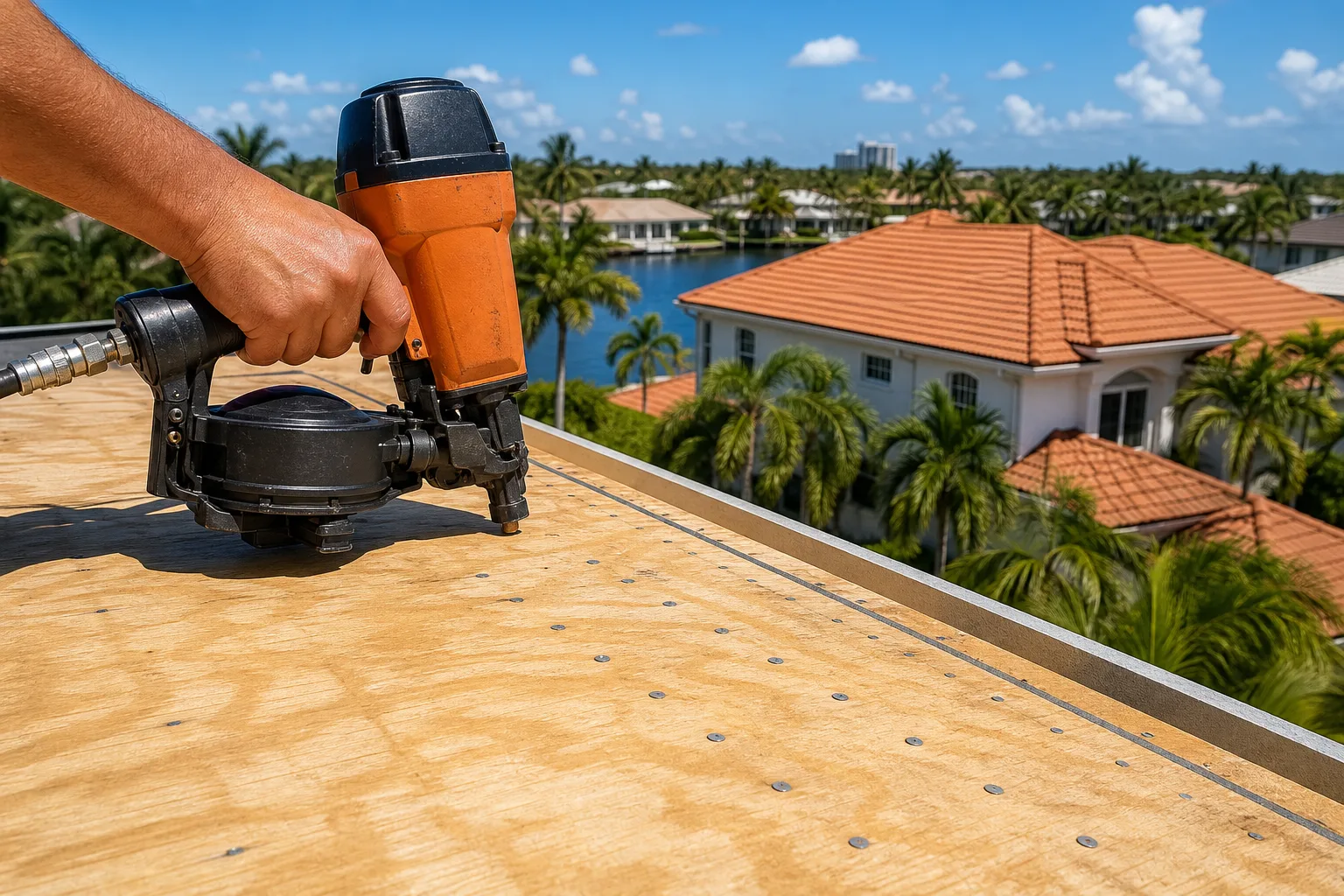
The pattern change was significant. Where older construction might have used a 6-inch field spacing and 12-inch perimeter spacing for roof deck screws or nails, current Florida code often requires a tighter 6-inch-by-6-inch schedule throughout the deck, with additional requirements at roof edges and corners where wind uplift is highest.
For shingles specifically, the number of nails per shingle and their placement relative to the nail strip directly affects whether the shingle lifts or stays seated under negative pressure. Manufacturers publish a required nailing pattern on every shingle bundle; that pattern is the minimum for the product's wind-rating warranty to apply.
Why It Matters
Wind uplift does not hit a roof uniformly. Corners and rakes experience pressure roughly two to three times higher than field areas during a major storm, according to research underlying ASCE 7 wind load standards. Fastener schedules are designed to account for this, using tighter spacing at perimeters and corners.
If your roof was installed before the post-Andrew code updates, or if a crew simply did not follow the schedule, the deck can separate from the trusses before the shingles ever peel. Once the deck goes, the rest of the structure is exposed in minutes.
Three variables that determine fastener performance:
- Gauge and type. Ring-shank nails hold significantly better in withdrawal than smooth-shank nails. Florida code specifies minimum shank diameter and ring-shank requirements for wind-rated applications.
- Penetration depth. A nail that does not fully penetrate the truss or rafter chord provides a fraction of the withdrawal resistance of a properly driven fastener. Over-driven nails that break the sheathing surface also lose holding strength.
- Pattern and spacing. Tighter spacing distributes uplift loads across more fasteners. The perimeter zone, which runs roughly 4 feet in from the roof edge, requires closer spacing than the field under current Florida code.
For metal roofs, the fastener schedule is built into the panel system's Florida Product Approval. Each approved assembly lists the exact screw type, spacing, and substrate required for the wind speed rating to hold. Deviating from that schedule voids the approval.
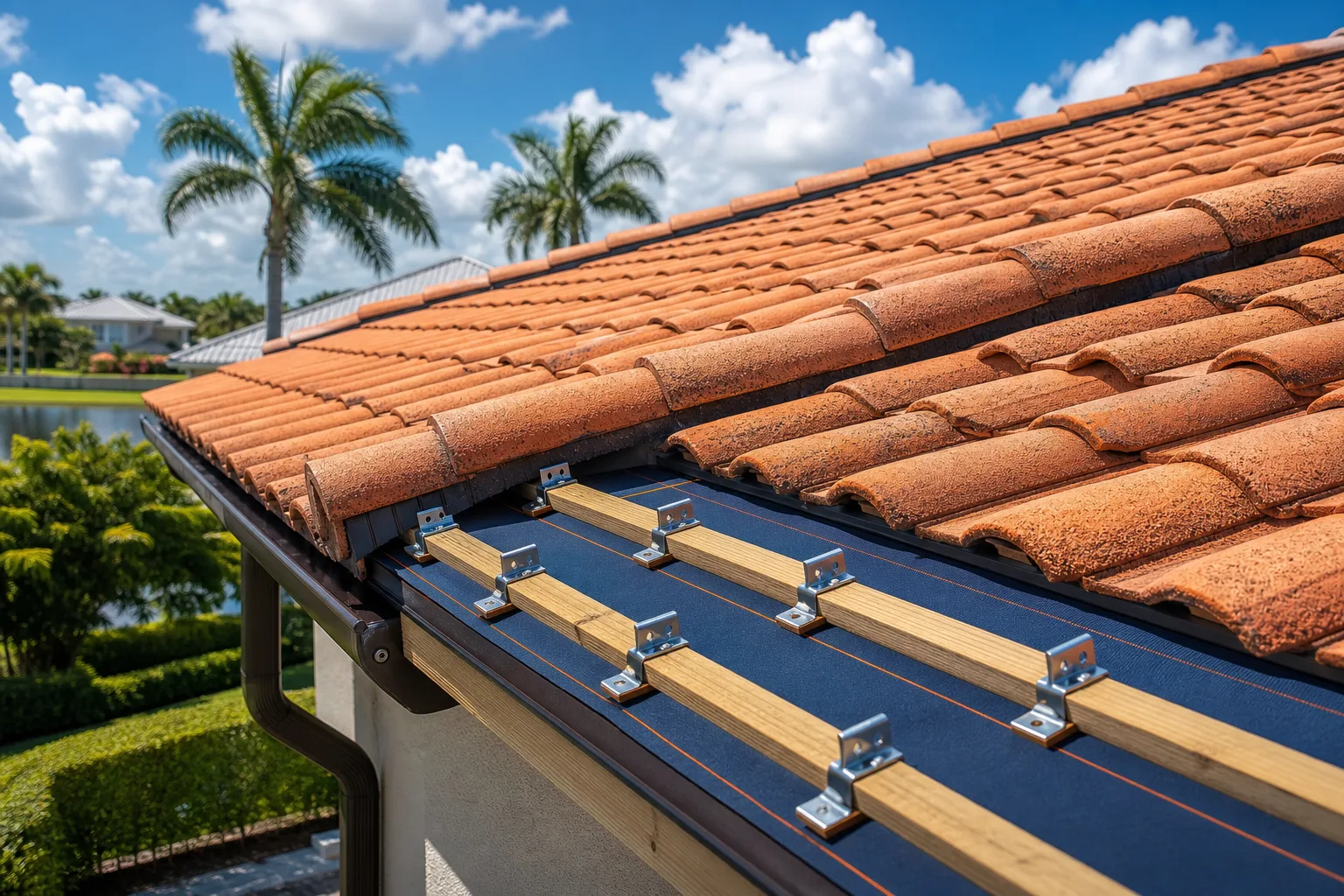
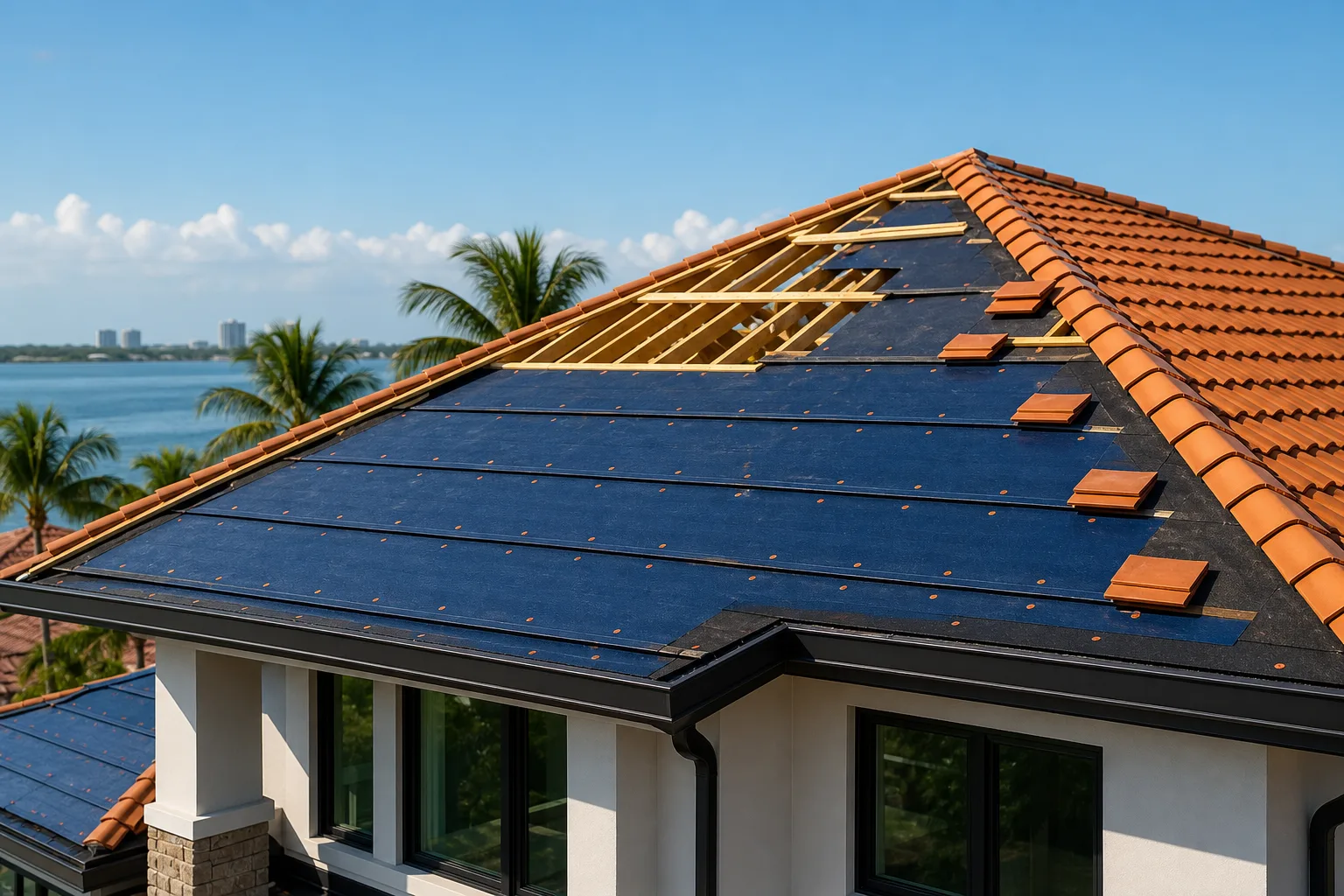
For tile roofs, the interaction between fasteners and the underlayment system matters as much as the tile attachment itself. See what goes beneath roof tiles for more on how those layers work together.
Is your roof ready for hurricane season? Visit the Storm Center
What We Don't Know Yet
Most homeowners have no easy way to verify their current fastener schedule without a professional inspection. Pulling a section of soffit or attic access can reveal how nails penetrate the deck, but assessing the full perimeter zone and corner treatment typically requires a licensed contractor or engineer to walk the roof and probe suspect areas.
Insurance carriers increasingly request a Wind Mitigation Inspection (form OIR-B1-1802 in Florida) to verify nailing patterns before granting premium credits. Inspectors use a probe to test nail withdrawal resistance and assess whether the deck meets the enhanced nailing category, which can qualify a home for meaningful premium reductions. Whether your home qualifies depends on when it was built and whether any re-roofing since then brought it up to current code.
It is also worth noting that code-minimum is not the same as best-available. Some contractors install at code minimums; others use ring-shank nails and tighter spacing as standard practice even when not strictly required.
What to Do About It
If your roof was installed before 2002 and has not been replaced, assume the fastener schedule may not meet current Florida code requirements.
Practical steps:
- Request a Wind Mitigation Inspection before hurricane season if you have not had one recently. The report will document your current nailing pattern category and whether you qualify for insurance credits.
- Ask during any re-roofing estimate what fastener gauge, type, and schedule will be used, and request that the product approval number for the roof assembly be noted on your permit documents.
- Check the attic after installation. From below, you should see nail tips penetrating through the deck into the truss chords at consistent spacing. Missing penetrations or clustered nails are a red flag.
- Review the perimeter and corners specifically. Ask your contractor to walk you through how the edge and corner zones are handled differently from the field.
If you are in Boynton Beach, Delray Beach, Boca Raton, West Palm Beach, or Lake Worth and want a professional set of eyes on your current roof before the season ramps up, request a quote or get a free instant estimate. For broader storm-prep resources, the Hurricane Storm Center covers what else to check before a named storm.
For roofs that just need a repair rather than a full replacement, roof repairs covers what that process looks like and when it makes sense.
Is your roof ready for hurricane season?
A pre-season inspection is the cheapest insurance you'll ever buy. Our Storm Center has you covered before and after the storm.
Frequently asked questions
What is a Wind Mitigation Inspection and does it affect my insurance?
A Wind Mitigation Inspection is a formal assessment, documented on Florida form OIR-B1-1802, that evaluates features like roof covering type, deck attachment, and opening protection. If your roof meets the enhanced nailing category or better, your insurer may reduce your wind premium. The savings vary by carrier and policy but can be substantial enough to offset the inspection cost in the first year.
How do I know if my current roof uses ring-shank or smooth-shank nails without tearing anything open?
A Wind Mitigation Inspector uses a probe tool to test nail withdrawal resistance and can often determine nail type from that test combined with permit history. Short of a professional inspection, you can sometimes check permit records from your county for the product approval used during installation, which will specify the nail type required.
Does a metal roof have different fastener requirements than a shingle roof in Florida?
Yes. Metal panel roofs are installed under a Florida Product Approval that specifies the exact screw type, diameter, spacing, and substrate for each wind speed zone. The fastener schedule is part of the approved assembly, so any deviation, including substituting screw types or increasing spacing, can void the approval and the associated wind rating. See the metal roofs page for more on how those systems are specified.
If I add a layer of shingles over existing ones, does the original nailing pattern still count?
Re-roofing over an existing layer does not update the deck attachment beneath. The Wind Mitigation form distinguishes between the roof covering and the deck-to-structure connection, and the deck nailing category is based on the original installation. A full tear-off and replacement is the only way to bring the deck fastening up to current code and qualify for the enhanced nailing credit.