5 Signs Your Flat Roof Membrane Is Failing Before a Leak Starts
In this article
TL;DR: Flat roof membranes telegraph failure well before they leak. Blistering, seam separation, surface cracking, ponding patterns, and flashing lift are the five signs to catch early. Spot them now and you are looking at a repair. Miss them and you may be looking at deck replacement.
Flat roofs dominate commercial buildings and a significant share of South Florida homes, especially mid-century construction in Boynton Beach, Delray Beach, and West Palm Beach. The membrane, whether TPO, EPDM, or modified bitumen, is a single continuous barrier. When it starts to go, it rarely announces itself with an immediate drip. It gives you warnings first.
Here is what to look for before water finds a way in.
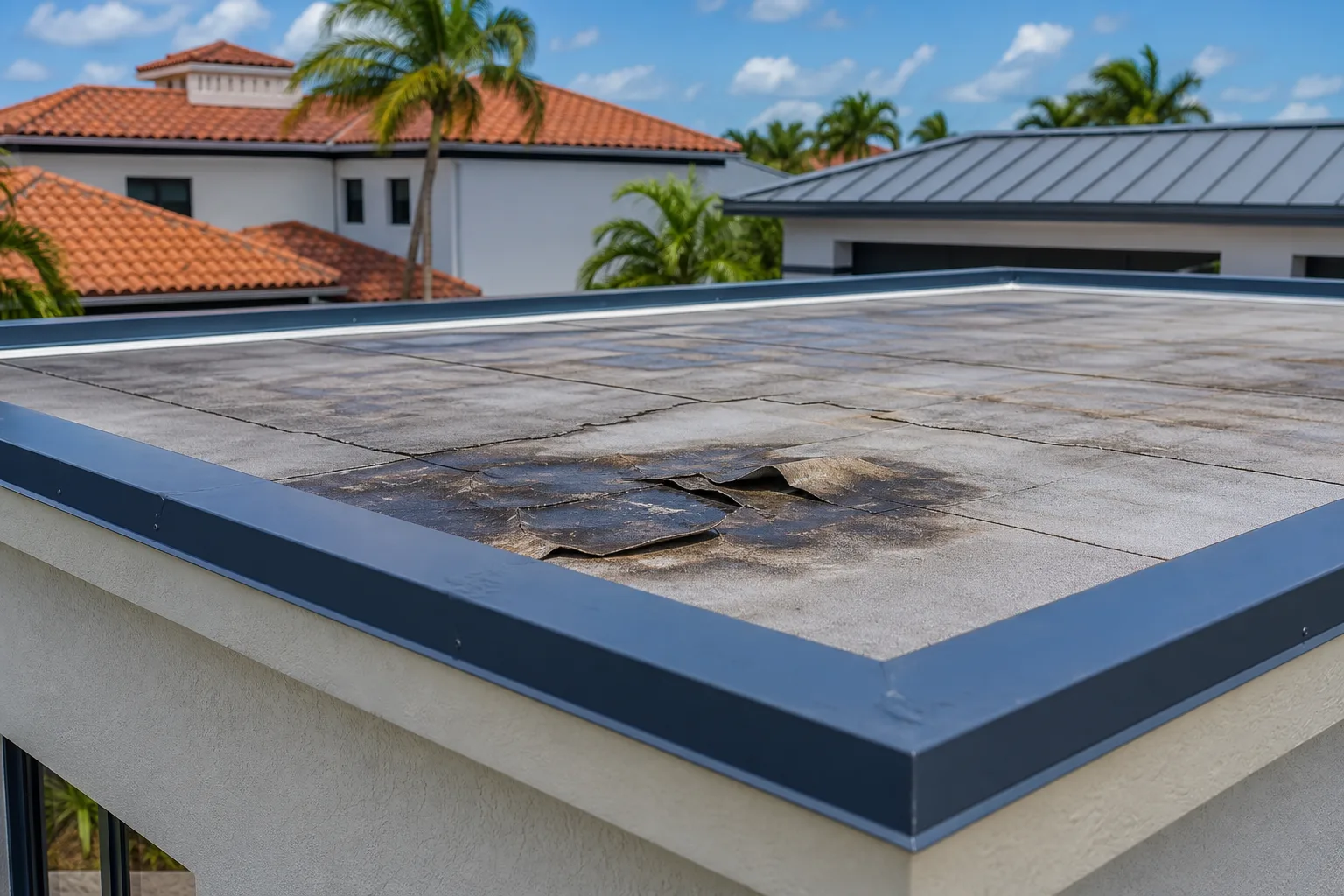
1. Blistering or Bubbling Across the Field of the Membrane
Blisters are raised pockets where the membrane has separated from the insulation or substrate beneath it. They form when trapped moisture or air expands under South Florida's intense heat. A blister that is still intact has not leaked yet, but the membrane at its edge is under stress and thinning.
Press a blister gently. If it is soft and moves like a bubble, moisture is likely already beneath the membrane at that spot. A firm blister may be an air pocket, which is less urgent but still a defect worth monitoring. Either way, a field of blisters across a large area is a sign the membrane adhesion is failing broadly, not just at one point.
Roofing industry standards require membranes to resist wind uplift and maintain a continuous weather barrier. A blistered membrane is compromised on both counts.
2. Seam or Lap Separation
Every flat roof membrane has seams where sheets overlap and are bonded together. Those seams are the weakest points in the system, and heat cycling, UV exposure, and South Florida's wet-dry season cause the adhesive or heat weld to fatigue over time.
Look for seams where the edge of one sheet is lifting slightly or where you can slide a finger between layers. Even a millimeter of separation is enough for wind-driven rain to work its way under during a storm. By the time a separated seam produces a visible interior ceiling stain, water may have been traveling laterally under the membrane for weeks.
This is especially worth checking before hurricane season. A partially separated seam that holds in a typical afternoon thunderstorm can fail completely under the sustained winds of a tropical system. See the Hurricane Storm Center for pre-season prep timing.
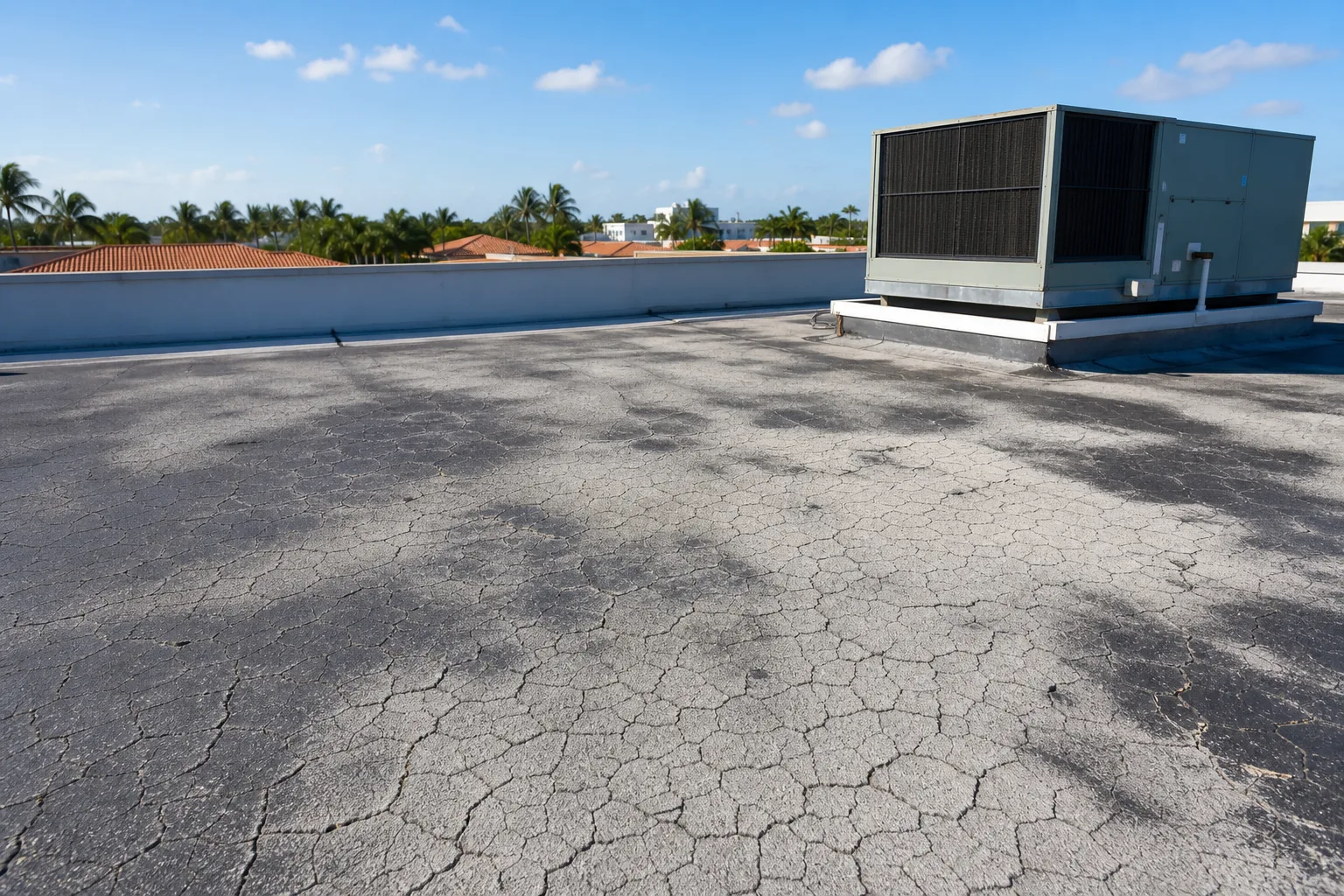
3. Surface Cracking or Alligatoring
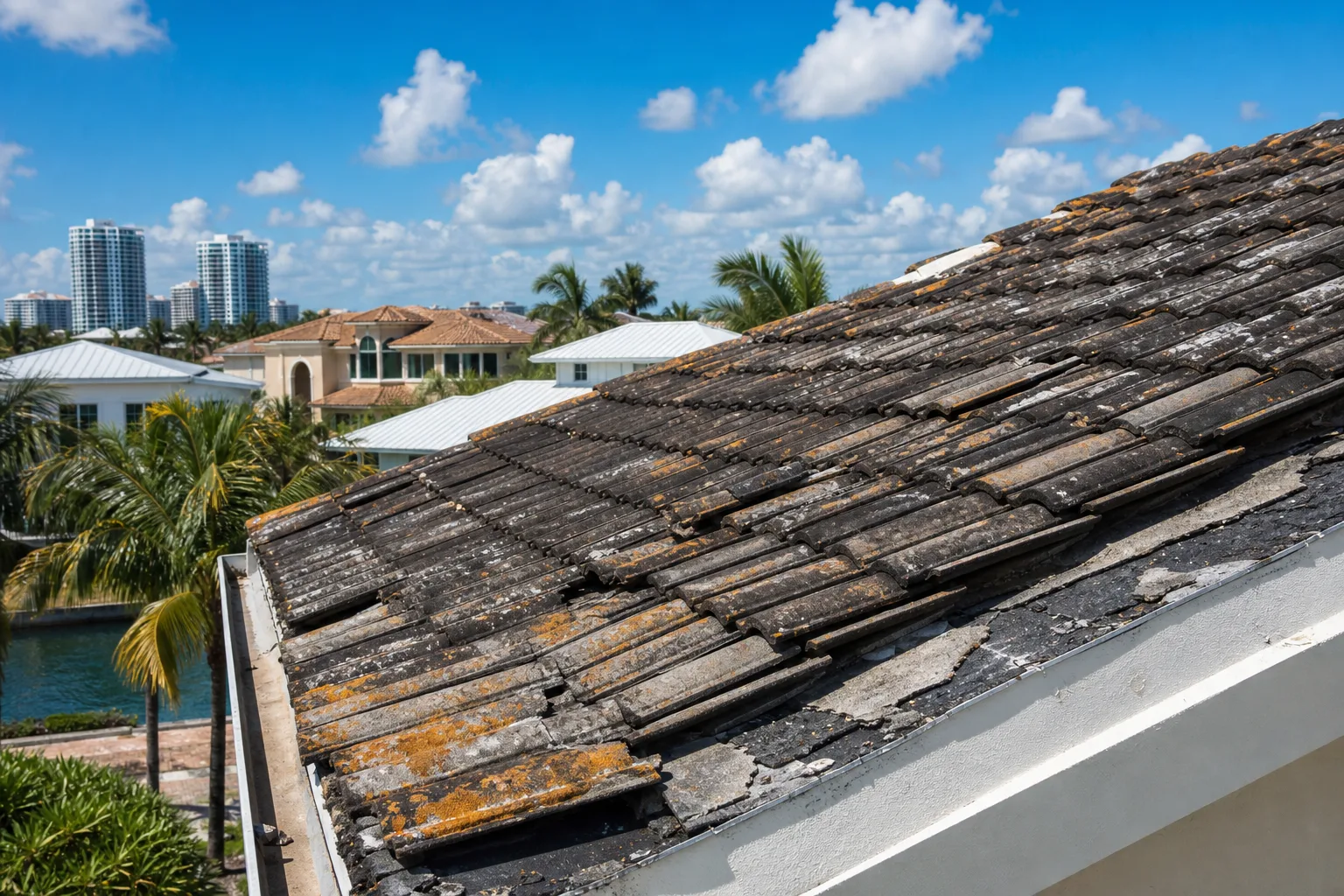
Modified bitumen and older built-up roofing systems develop surface cracking as the oils in the asphalt dry out over years of UV exposure. The pattern looks like the skin of an alligator, which is exactly what Florida contractors call it.
Alligatoring is not just cosmetic. Those cracks are stress fractures in the waterproofing layer. Rain penetrates the cracks, freezes and expands in the rare cold snap, then works deeper. In South Florida's climate the temperature cycling is less extreme than the North, but the UV degradation is far worse. A surface that is visibly alligatored has lost most of its elasticity and will crack through to the substrate with one more season of thermal movement.
If you see this pattern, the question shifts from repair to replacement. The companion post Flat Roof Repair vs. Replacement: When to Choose walks through that decision in detail.
Protecting a commercial property? Request a commercial assessment
4. Pooling Patterns and Drain Ring Staining
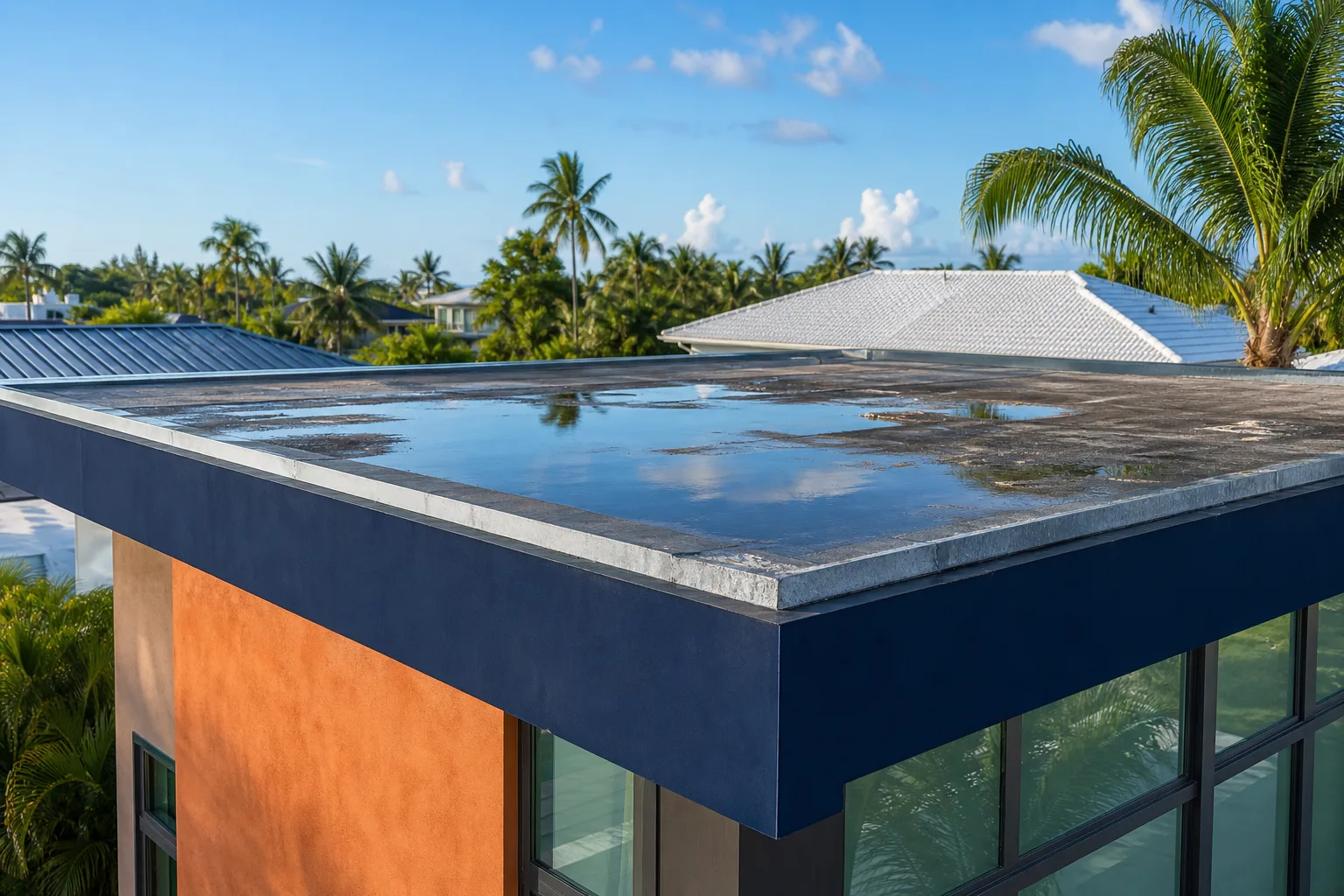
Some ponding on a flat roof after heavy rain is normal for the first 24 to 48 hours. Anything standing beyond that is a drainage problem, and drainage problems accelerate membrane failure. Constant moisture contact degrades adhesives, encourages biological growth, and adds structural load.
You do not have to wait for rain to read the drainage story. Look for dark discoloration in low spots, algae or moss growth in a consistent area, or a white mineral ring around drains and scuppers. That ring is efflorescence, a deposit left as water evaporates repeatedly in the same location. It tells you water is sitting there after every rain.
The related post Standing Water on a Flat Roof: What Happens covers how quickly ponding accelerates membrane breakdown. At the drain itself, check that the drain collar is still flush with the membrane. A drain that has settled or a collar that has separated is a near-term leak site.
5. Flashing Lift at Walls, Curbs, and Equipment Penetrations
The field of a flat roof membrane tends to outlast its termination points. Anywhere the membrane turns vertical, wraps around a curb, or seals against an HVAC unit base, parapet wall, or pipe boot, you have a transition that takes more mechanical stress than the flat field.
Check these transitions closely. Look for flashing that is pulling away from the wall, caulk that has cracked and separated, or metal counter-flashing that is no longer overlapping the membrane edge. Lift is sometimes subtle, just a slight bow outward at the top edge, but that gap is where wind finds purchase during a storm.
Industry standards and most roof assembly specifications require flashing to maintain continuous contact with the substrate. Flashing that has lifted may be flagged as a pre-existing deficiency and could potentially affect your insurance claim outcome if a storm loss occurs at that location, though results will vary depending on your specific policy terms and adjuster findings. Insurers increasingly document whether pre-existing conditions contributed to a loss.
Bottom Line
None of these five signs requires water inside your building to be real. Blistering, seam separation, alligatoring, chronic ponding, and flashing lift are all visible on the roof surface right now, before any interior damage occurs. That is the window when a targeted repair is still an option.
If you are managing a commercial property or own a flat-roofed home in South Florida, a pre-season roof walk is worth scheduling before June. A qualified contractor can document current conditions, which also protects you if you need to file a claim later in the season.
Request a quote for a flat roof inspection or use the instant estimate tool to start the conversation. For commercial properties specifically, the commercial roofing services page has more on what a membrane assessment covers.
Protecting a commercial property?
We handle flat, tile, and metal commercial roofs across Palm Beach County with minimal disruption to your operation.
Request a commercial assessment
Frequently asked questions
How often should a flat roof membrane be inspected in South Florida?
Twice a year is a reasonable baseline: once before hurricane season (May) and once after it ends (December). South Florida's UV intensity and storm frequency accelerate wear faster than in most other U.S. climates, so annual inspections that work for northern buildings are often not enough here.
Can a flat roof membrane be patched, or does the whole membrane need to be replaced?
Individual blisters, small seam separations, and isolated flashing failures can often be patched if the surrounding membrane is still in good condition. Widespread alligatoring or adhesion failure across a large area of the field usually means a full replacement is more cost-effective than repeated patching. A qualified inspector can tell you which situation you are dealing with.
Will my homeowner's or commercial property insurance cover membrane failure?
Sudden storm damage to a membrane is typically a covered peril. Pre-existing deterioration, including blistering, alligatoring, or separated seams that existed before a storm, is usually excluded. Documenting current roof condition before hurricane season gives you a baseline that can support a claim if wind later causes further damage.
Does standing water on a flat roof void the manufacturer warranty on the membrane?
Many membrane manufacturers require a minimum slope and functional drainage as a condition of their warranty. Chronic ponding beyond 48 hours can void warranty coverage on some systems. Check your membrane warranty documents or ask your roofing contractor to review the terms before assuming ponding is covered.