What Roofers Do When They Find Wet Insulation Under a Flat Roof
In this article
TL;DR: Wet insulation under a flat roof cannot be dried in place, it has to come out. Roofers use moisture readings and visual inspection to map the saturated area, remove everything that tests wet, and replace it before the new membrane goes down. Leaving wet material under a new roof is one of the most common ways a re-roof job fails early.
What You Need
Before starting any flat roof tear-off or repair, a roofer needs a few specific tools and a clear process. Without them, it is easy to miss saturated pockets and re-cover them.
- Infrared or capacitance moisture meter. These are the two most practical field tools for mapping wet insulation without tearing up the whole deck.
- Probe or core cutter. A meter gives a reading; a probe or small core confirms what the reading means.
- Chalk or spray paint. Used to mark the wet boundary on the membrane before tear-off begins.
- Dumpster or haul-away plan. Saturated insulation is heavy. A job that looked like a small repair can generate a surprising amount of wet debris.
- Replacement insulation matched to the existing assembly. Polyisocyanurate (polyiso) is standard on South Florida commercial flat roofs. The replacement board needs to match thickness and R-value.
Step 1: Map the Wet Area Before Touching the Membrane
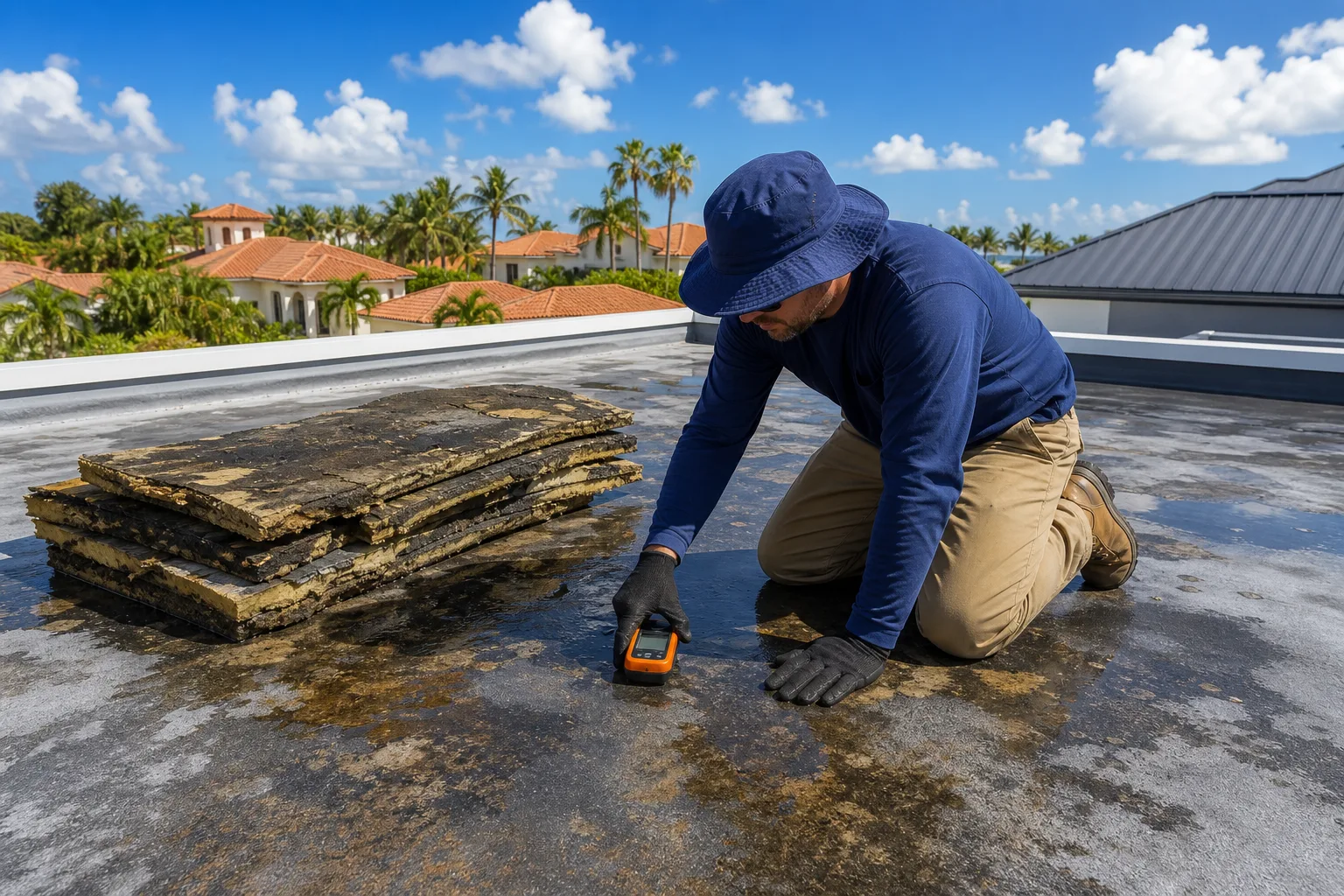
The first thing a roofer should do is walk the entire roof surface with a moisture meter before any material comes off. Wet insulation holds heat longer than dry insulation, so an infrared scan done in the late afternoon, after the sun has started to drop, can show the saturated zones as warm patches against a cooling background.
Capacitance meters work in daylight and don't require a temperature differential. Either tool gives you a rough map. The key word is rough. You still need to verify with a core sample or probe before marking cut lines.
Mark the wet boundary with chalk or paint. Add at least 12 inches of dry buffer around any flagged area, because moisture wicks laterally through the insulation board before it shows up on a scan.
Step 2: Perform Core Cuts to Confirm Depth
A core cut is exactly what it sounds like: a small hole cut through the membrane and insulation layers down to the deck. It tells you how many layers are wet, whether the deck itself is compromised, and what the existing assembly actually looks like.
On a re-cover or a roof that has been patched multiple times, you can find two or three layers of old insulation stacked under a single membrane. Each layer needs to be tested individually. Wet material in the bottom layer but dry material on top is common, and it still has to come out.
If the core cut reveals moisture at the deck level, the job scope changes. A wet wood or concrete deck needs to dry before new insulation goes down. A rotted wood deck needs replacement. This is where many homeowners and building owners get surprised by scope changes mid-job. It is not the roofer padding the bill; it is physics.
Step 3: Remove Everything That Tests Wet
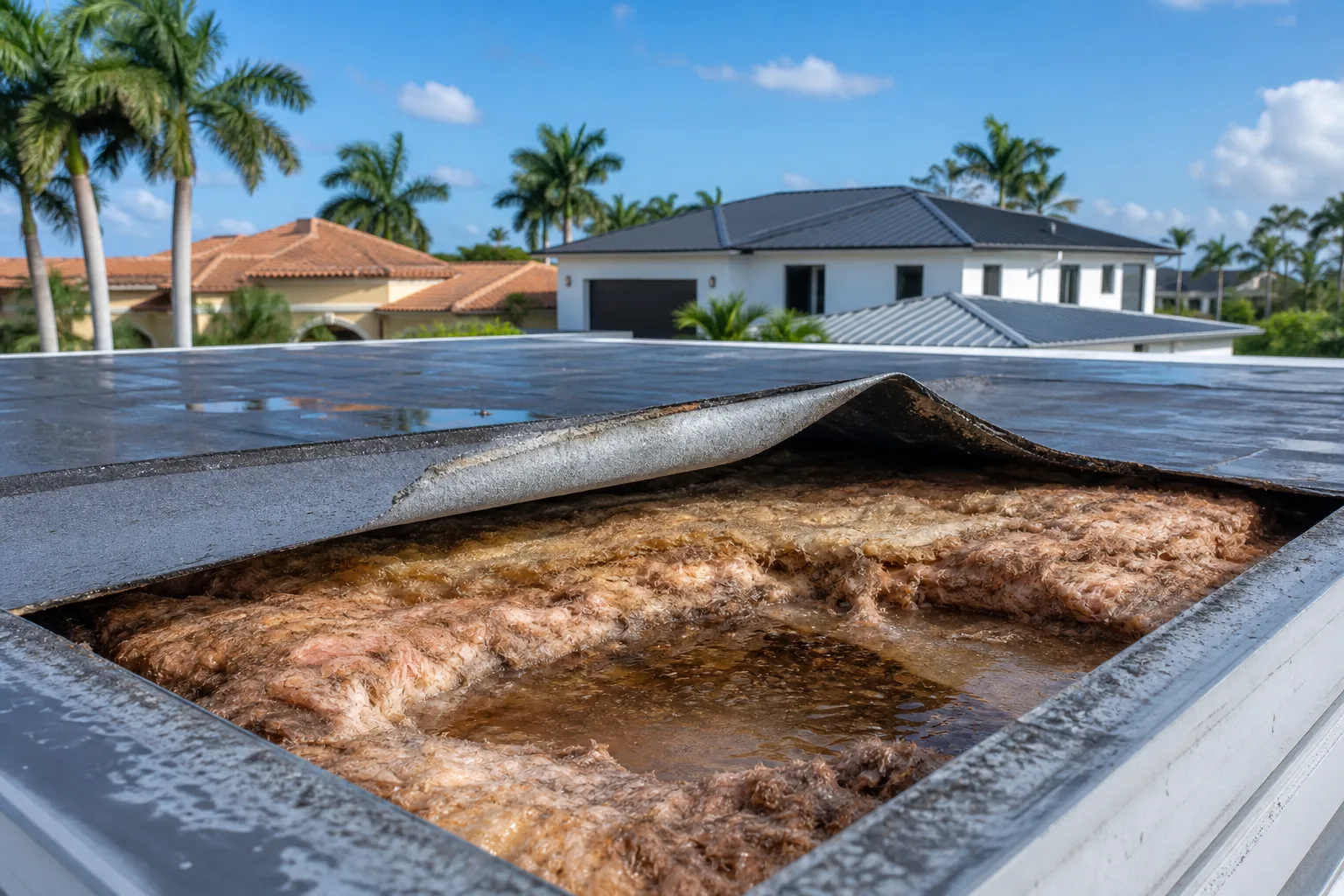
There is no salvaging saturated insulation. Polyiso or fiberglass-faced insulation board that has absorbed water will not dry once it is re-covered. It will continue to hold moisture against the deck, accelerate corrosion on metal fasteners, and promote mold growth in a building system that has no way to ventilate.
Cut back to the dry boundary confirmed by your cores, not just what the meter showed on the surface. Pull the wet boards, bag or stage them for disposal, and inspect the deck underneath.
If you find only isolated pockets of wet insulation, say two or three boards in a larger field of dry material, a targeted replacement can work. If more than 25 to 30 percent of the roof area tests wet, a full tear-off is usually the more cost-effective path once you factor in the labor to work around the dry material.
Protecting a commercial property? Request a commercial assessment
Step 4: Inspect and Prep the Deck
Once the wet insulation is out, the deck gets a close look. On commercial flat roofs in South Florida, the deck is typically concrete, steel, or structural wood panels.
- Concrete decks: Look for spalling, efflorescence, or cracks. Light surface rust on embedded rebar visible at a crack is a flag. The deck should be clean and dry before insulation goes back down.
- Steel decks: Check for surface rust and any corrosion at the flute edges. Light rust can be treated; deep pitting or section loss is a structural issue that goes beyond roofing.
- Wood decks: Probe for soft spots. Any spongy or delaminated section gets replaced. This is non-negotiable.
The deck also needs to be dry to a moisture reading acceptable for the new adhesive or fastener system being used. The insulation manufacturer and membrane manufacturer both publish acceptable moisture thresholds. A good roofer checks those specs, not just the deck by feel.
Step 5: Install Replacement Insulation and New Membrane
Replacement insulation goes in to match the existing assembly thickness. If the existing roof used two layers of polyiso with staggered joints, the replacement should do the same. Skipping the staggered joint detail creates a thermal bridge and a future leak path at every seam.
Fasten or adhere the new insulation according to the membrane manufacturer's requirements for the specific wind zone. South Florida sits in a high-velocity hurricane zone, and the fastener pattern for this region is not the same as the rest of the country. This is one place where a contractor who works in multiple states can get it wrong if they aren't paying attention to the Florida Building Code requirements.
The new membrane then goes over the replacement boards with the same system already on the roof, TPO, modified bitumen, or fluid-applied, so the transition is clean and the warranty on the new material is not voided by a mismatched substrate.
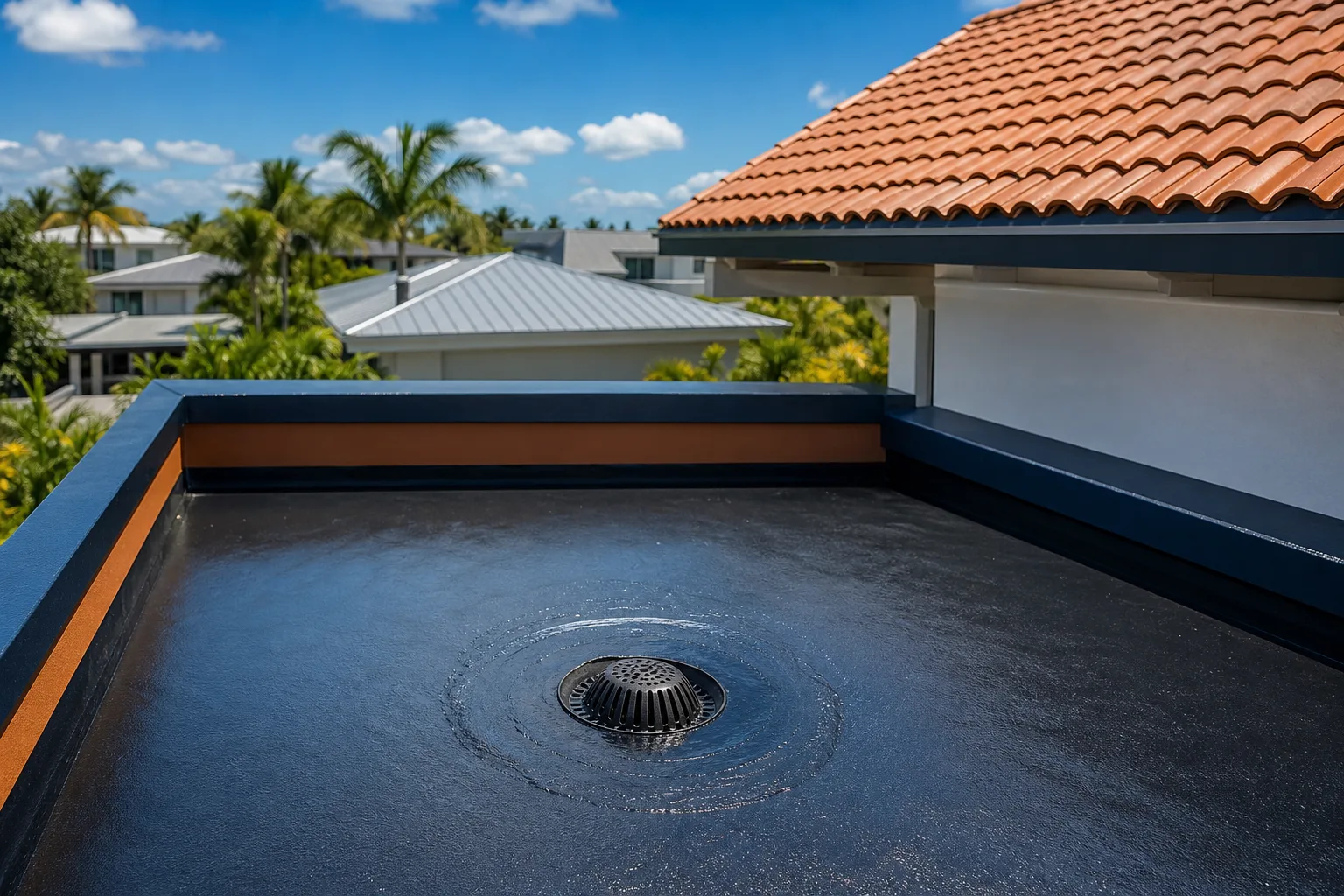
For details on how water is managed at the flat roof drain before this point, see how roofers waterproof a flat roof drain that keeps backing up.
Common Mistakes
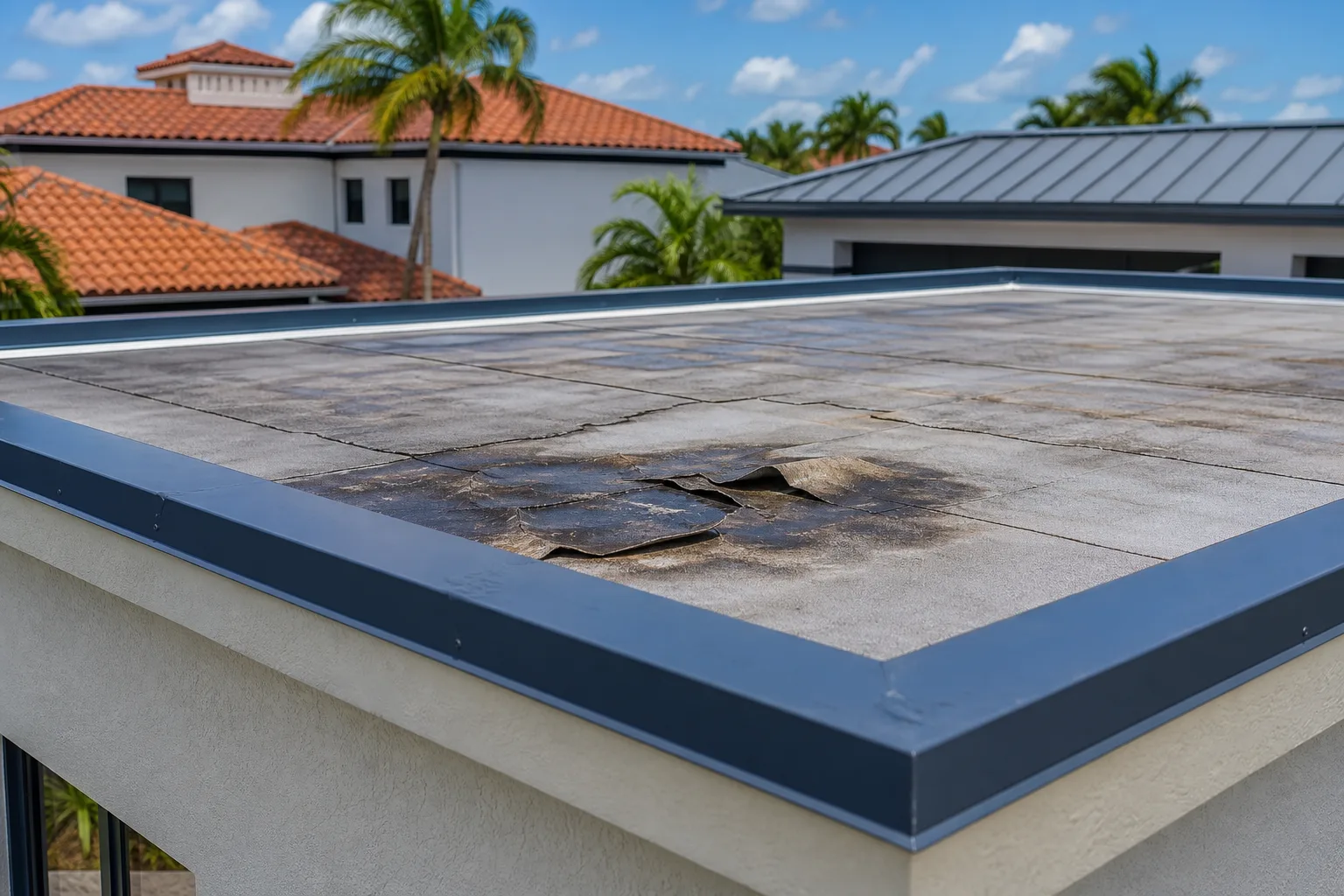
Re-covering wet insulation. This is the big one. A new membrane over wet insulation will blister, delaminate, and leak within a few years. Some contractors skip the moisture scan to keep the bid low. If a bid doesn't mention moisture testing, ask why.
Stopping at the visible damage. Cutting out only the area with an obvious blister or seam failure and leaving the surrounding wet material is a temporary fix at best. Wet insulation spreads. The core sample is there to find that spread.
Mismatching insulation thickness. Installing a thinner replacement board creates a low spot that ponds water and stresses the membrane at the seam between old and new material.
Skipping deck prep. New insulation installed over a damp deck traps that moisture just as effectively as re-covering saturated insulation. The deck has to be dry.
Using the wrong fastener pattern. South Florida wind uplift requirements are serious. A fastener pattern designed for a lower wind zone is not code-compliant here and will not hold in a named storm. If you're not sure about your existing commercial roof's condition before hurricane season, the storm center has resources worth reviewing.
Bottom Line
Wet insulation under a flat roof is not a situation where you can patch over the problem and move on. The right process is to map it, confirm it with cores, remove everything that tests wet, prep the deck, and install matched replacement material before the new membrane goes down. That sequence takes more time and sometimes costs more than a homeowner or building owner expects, but it is the only way a re-roof or repair holds up over the next decade in South Florida's climate.
If you have a flat roof that's been leaking, or you're not sure whether a previous repair was done correctly, request a quote or use the instant estimate tool to get a conversation started. For commercial flat roofs specifically, the commercial roofing page covers what that process looks like from start to finish.
Protecting a commercial property?
We handle flat, tile, and metal commercial roofs across Palm Beach County with minimal disruption to your operation.
Request a commercial assessment
Frequently asked questions
Can wet insulation dry out if you leave it in place and just patch the membrane?
No. Once insulation board is saturated, it has no path to dry once it is re-covered. It will hold moisture against the deck indefinitely, accelerating corrosion and mold growth, and the new membrane above it will blister and fail early.
How do roofers tell the difference between a small isolated wet spot and widespread insulation damage?
A combination of infrared scanning and capacitance meter readings gives a surface map, but core cuts at multiple points across the roof confirm whether the wet zones are isolated or connected. If more than roughly 25 to 30 percent of the field tests wet, a full tear-off is usually the more practical and cost-effective choice.
Does a wet deck always mean the whole roof needs to be replaced?
Not necessarily. A concrete or steel deck that is wet but structurally sound can be allowed to dry and then sealed before new insulation goes down. A wood deck with soft, spongy, or delaminated sections does require replacement of the damaged panels before anything else happens.
How does South Florida's wind zone affect flat roof insulation installation?
Florida's high-velocity hurricane zone requires a specific fastener pattern and pull-out strength for insulation and membrane systems that exceeds what is used in most other states. Using an undersized fastener count or spacing not designed for this wind zone is a code violation and will not perform in a named storm.