Flat Roof Options for South Florida Commercial Buildings
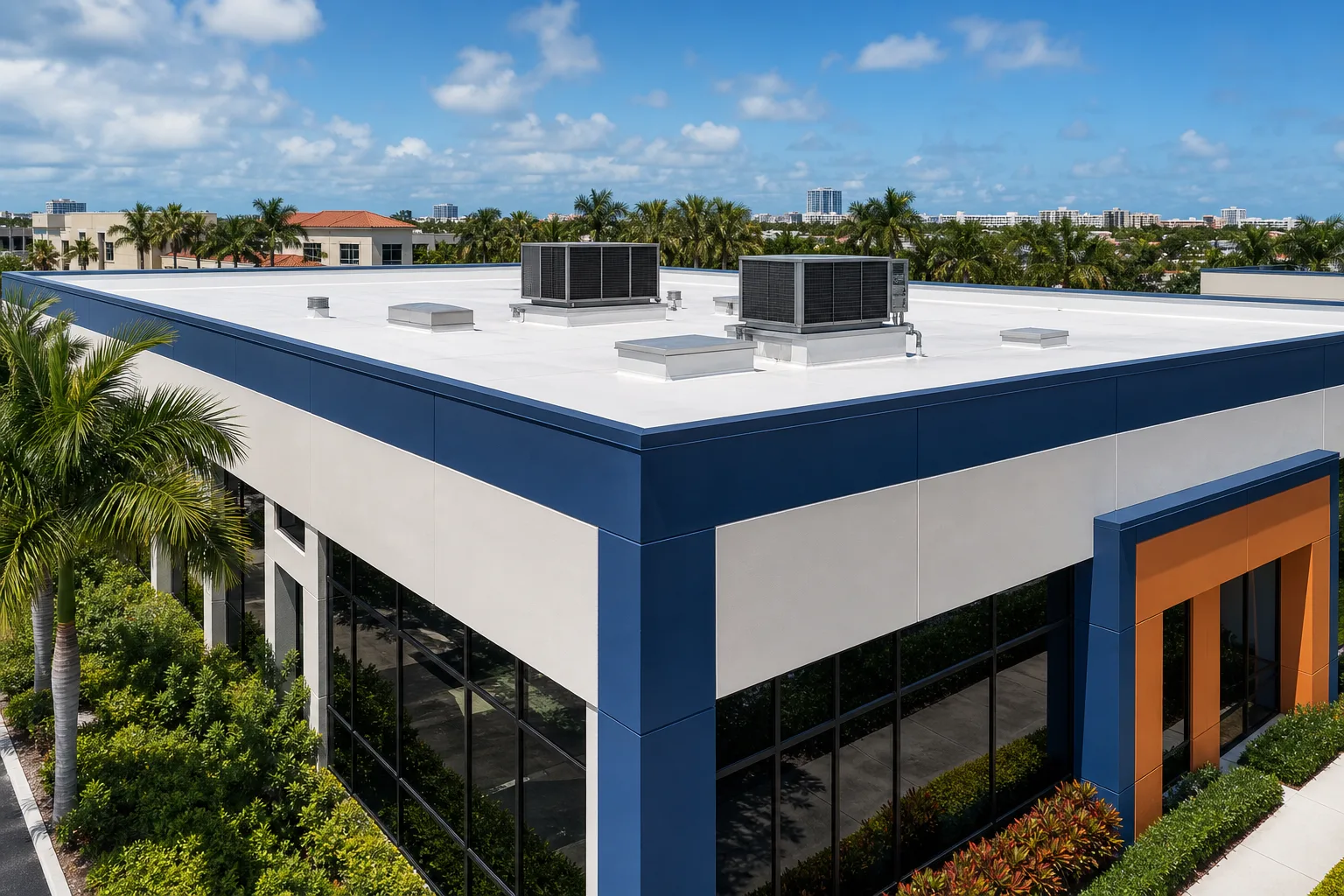
In this article
TL;DR: South Florida commercial flat roofs live in one of the harshest roofing environments on the planet. TPO and PVC single-ply membranes dominate new construction, modified bitumen is a solid choice for smaller or budget-constrained projects, and SPF (spray polyurethane foam) fills a niche for unusual shapes. The right choice depends on your roof deck, slope, HVAC foot traffic, and what your insurance carrier will accept after any forthcoming Florida Building Code updates.
What You Need
Before you call a contractor, pull together the following. It will save you two phone calls and make every conversation more productive.
- Current roof system type and approximate age
- Square footage and roof slope (even a rough figure helps)
- Whether you have rooftop HVAC units, walkway pads, or grease exhaust penetrations
- Any active leak history or prior repairs
- Your insurance carrier's current acceptable materials list (ask your agent specifically, not the 800 number)
- A copy of the most recent permit if one exists
You do not need to be an expert. You need to walk in with facts so a licensed contractor can give you an accurate scope, not a ballpark.
Step 1: Understand What "Flat" Actually Means in South Florida Code
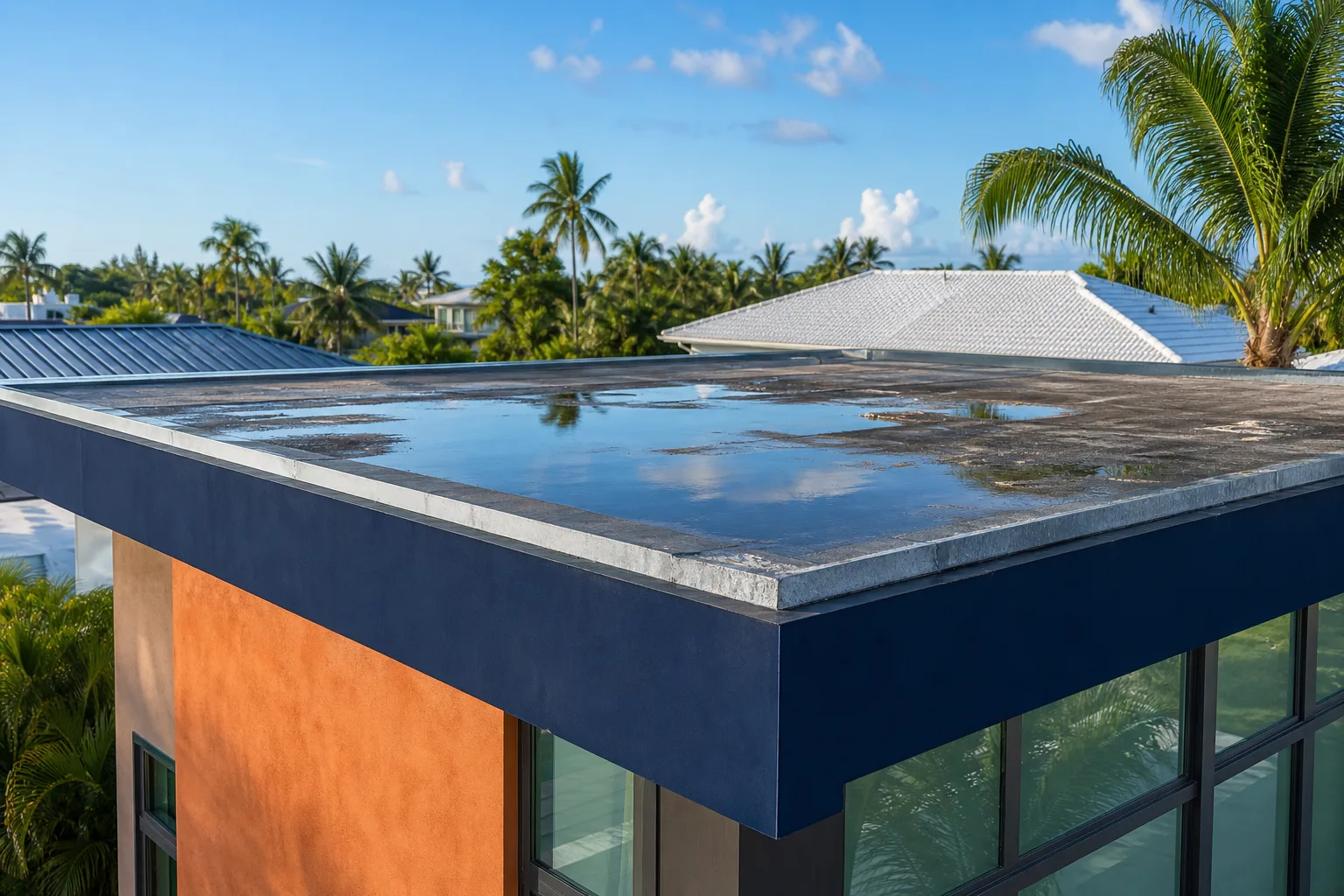
No commercial roof is truly flat. Florida Building Code generally requires a minimum slope of 1/4 inch per foot for low-slope membrane roofs, though you should confirm the specific requirement with your contractor against the current adopted code edition for your jurisdiction. This matters because standing water is the number-one killer of flat roofs in Palm Beach County. Ponding water, defined as water that remains on the surface 48 hours after rain stops, voids most manufacturer warranties and accelerates membrane degradation in our UV environment.
If your existing roof has drainage problems, no new membrane will fix them. A proper reroofing scope includes evaluating drain placement, adding drains or scuppers if needed, and sometimes adding tapered insulation to improve slope. Skip this step and you are buying the same problem twice.
The Florida Building Code reroofing requirements are worth reviewing with your contractor before you commit to a system. Re-cover rules, insulation R-value requirements, and wind uplift ratings continue to evolve. Your contractor's permit set needs to reflect the current adopted code, not what passed five years ago.
Step 2: Know Your Four Real System Options
TPO (Thermoplastic Polyolefin)
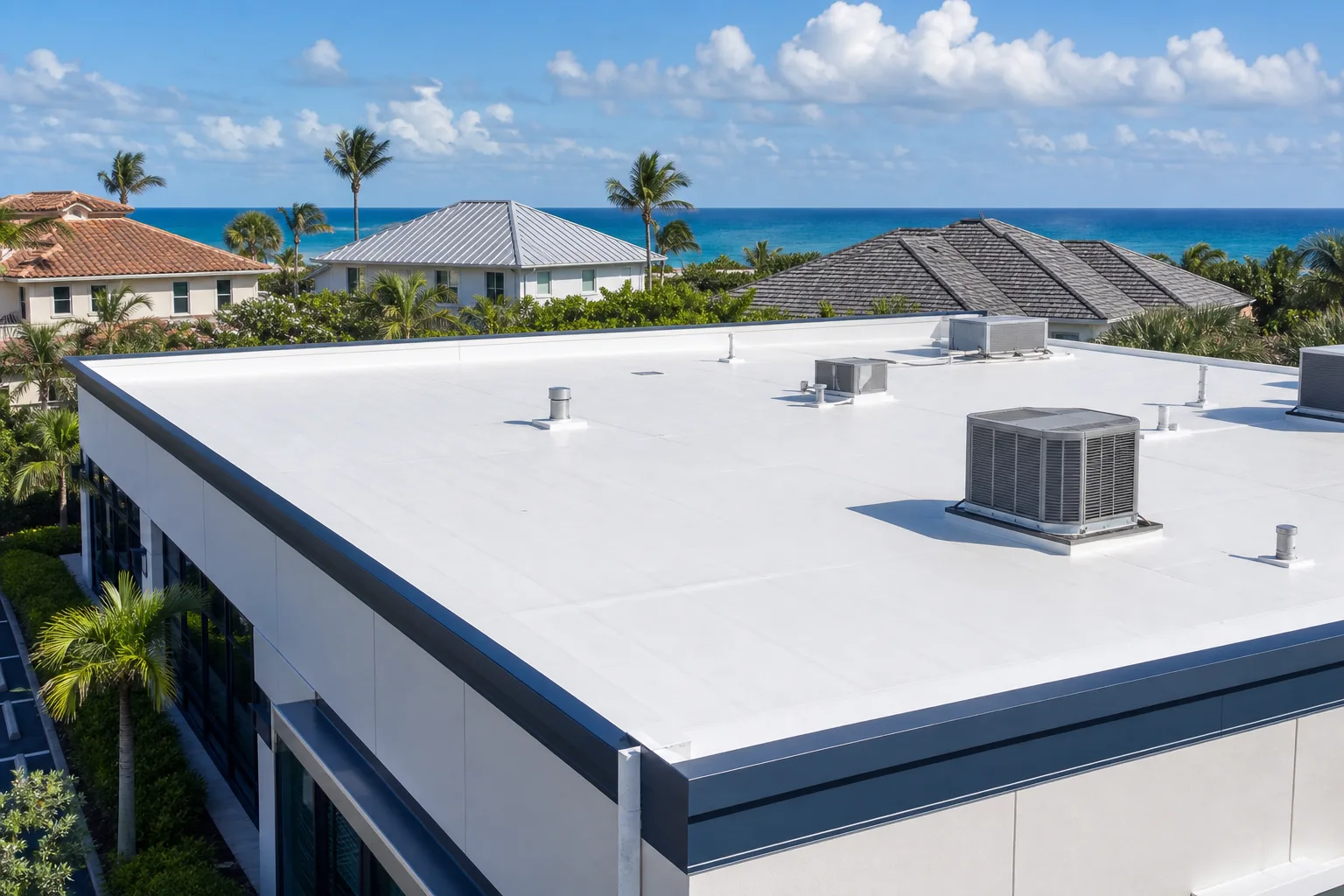
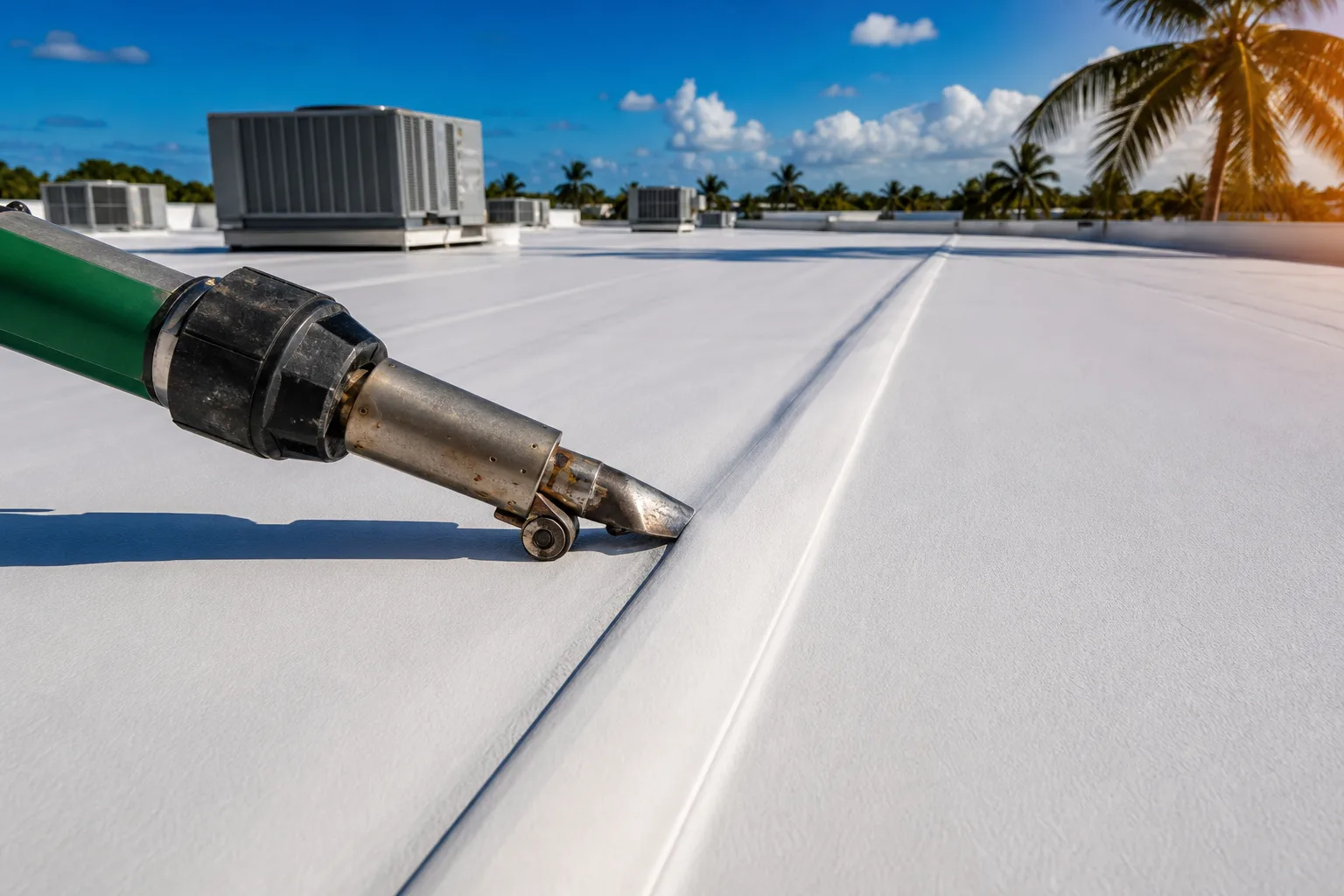
TPO is the most widely installed commercial flat roof membrane in South Florida right now, and for good reason. White or light-gray TPO reflects a significant portion of solar heat, which matters when your HVAC system is fighting 95-degree temperatures and full sun. It is heat-welded at the seams, which creates a continuous bond rather than a glued lap, and a properly welded seam is often stronger than the membrane itself.
Thickness matters. In South Florida, 60-mil TPO is the practical minimum for commercial applications. Thinner membranes get foot traffic damage quickly and are more vulnerable to puncture around penetrations. Some manufacturers offer 80-mil for high-traffic or mechanically attached applications.
Wind uplift is the critical performance spec for our market. Look for FM or UL-listed assemblies rated to meet or exceed the wind speed requirements for your county. Palm Beach County is a wind-borne debris region with significant wind design requirements, and the attachment method (fully adhered, mechanically attached, or ballasted) changes the uplift resistance profile significantly.
PVC (Polyvinyl Chloride)
PVC performs similarly to TPO in reflectivity and heat-welded seam strength. Where PVC stands out is chemical resistance. If your building has restaurant exhaust, grease traps, or chemical storage, PVC holds up better to petroleum-based contamination than TPO. The trade-off is cost: PVC typically runs higher per square than TPO, and it can become brittle in cold weather, though that is rarely a concern in Boca Raton or Delray Beach.
If your building has rooftop kitchen exhaust and you are replacing the membrane, PVC deserves a serious look. A grease-compromised TPO membrane fails at the seams and around penetrations faster than most property managers expect.
Modified Bitumen (Mod Bit)
Modified bitumen is the successor to traditional built-up roofing (the old tar-and-gravel systems). It comes in APP (atactic polypropylene) and SBS (styrene-butadiene-styrene) formulations. APP is torch-applied and performs well in direct sun. SBS is more flexible and can be cold-applied or self-adhered, which is useful on occupied buildings where torch work creates liability concerns.
Mod bit is a proven performer and still widely used on smaller commercial buildings, strip mall units, and budget-sensitive reroofing projects. It is not the cutting edge, but it is reliable when installed correctly by experienced hands. A granulated cap sheet adds UV and physical protection and gives you visible inspection points for damage.
For larger roofs, the labor cost of mod bit can approach or exceed TPO once you factor in the number of plies. Get a direct comparison in any competitive bid.
SPF (Spray Polyurethane Foam)
SPF is sprayed as a liquid and expands into a closed-cell foam layer, then gets coated with a silicone or acrylic top coat. It is seamless, which eliminates the most common failure point of other systems. It conforms to unusual shapes and roof details that give single-ply membranes trouble.
SPF is not for every building. It requires a clean, dry, prepared substrate. The coating must be renewed on a schedule, roughly every 10 to 15 years depending on exposure, or the foam beneath degrades. Contractor quality varies considerably. If you are considering SPF, verify the installer's experience with the specific coating product and ask for local references.
Step 3: Factor in Hurricane Wind Performance Before You Decide
Every flat roof system installed in South Florida must comply with the Florida Building Code wind uplift requirements for your location. This is not optional and it is not a formality. The edge detail (metal edge or termination bar) is consistently one of the first components to fail in a Cat 3 wind event. Perimeter and corner zones require higher attachment density than field areas.
When reviewing bids, ask specifically what FM or UL uplift assembly the contractor is using and whether the perimeter attachment pattern changes. If a contractor cannot tell you the assembly number, that is a problem.
Check your insurance carrier's requirements separately from code minimums. After recent storm seasons, some carriers in Palm Beach County have added their own requirements for attachment method and minimum membrane thickness. We recommend verifying your carrier's current standards with your agent before selecting a system, as mismatches between your installation and carrier requirements could potentially complicate a future claim. Our Hurricane Storm Center has updated guidance on what South Florida property owners need to know heading into any active season.
Protecting a commercial property? Request a commercial assessment
Step 4: Plan Around Penetrations, HVAC, and Foot Traffic
A flat roof with rooftop HVAC equipment is a different animal than an empty field membrane. Every curb, pipe boot, conduit penetration, and drain is a potential leak point. Detail work, the flashing and sealing around these penetrations, is where inexperienced installers cut corners and where most commercial roof leaks actually originate.
Ask to see photos of completed penetration details from any contractor you are considering. Our project gallery shows real completed work if you want a reference point for what quality detail work looks like.
If technicians or HVAC crews walk your roof regularly, add walkway pads to the scope. A 60-mil TPO field membrane is not designed for repeated foot traffic without protection. Walkway pads cost a fraction of a membrane repair and prevent the kind of slow damage that goes unnoticed until it is a leak.
Step 5: Get the Right Contractor and the Right Documentation
Commercial roofing in Florida requires a licensed contractor. The license class you want is a roofing contractor's license (CCC prefix) or a general contractor with demonstrated roofing scope. Verify any contractor's license at the Florida DBPR before signing anything.
Your bid package should include the specific membrane product and thickness, the attachment method and FM/UL assembly number, the insulation R-value and type, the metal edge or termination detail, and the manufacturer warranty terms. A 20-year manufacturer warranty means something only if the installation meets the manufacturer's requirements, which typically includes a contractor approval program and a post-installation inspection.
For commercial projects, pull the permit yourself or verify your contractor pulls it. An unpermitted commercial roof replacement can complicate a sale, a refinance, or an insurance claim in ways that are expensive to unwind. See our commercial roofing services page for more on what a properly scoped commercial project looks like from our end.
If you want a preliminary number before the full conversation, our instant estimate tool is a reasonable starting point.
Common Mistakes
Choosing a system based on lowest installed cost alone. A cheaper membrane that requires re-coating in seven years or fails at seams after one hurricane season is not a bargain.
Skipping the drainage evaluation. New membrane over a roof with ponding problems will fail prematurely. Address the drainage first.
Not verifying the wind uplift assembly. A membrane installed with the wrong fastener spacing in the perimeter zone is a code violation and an insurance exposure.
Ignoring penetration and edge details in the bid. Ask specifically how every curb, pipe boot, and edge condition will be handled. Vague answers are a red flag.
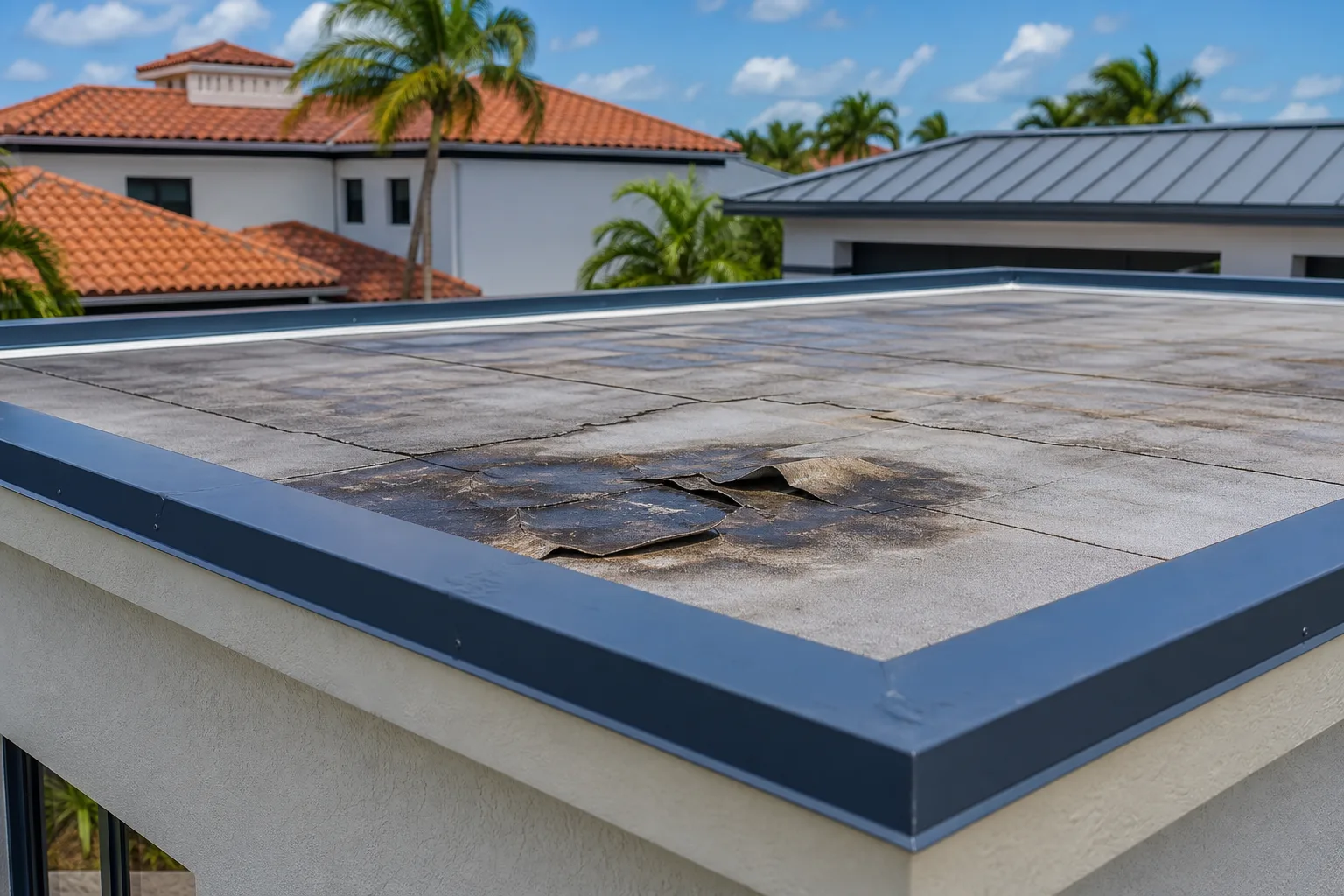
Accepting a warranty without reading the maintenance requirements. Most commercial membrane warranties require periodic inspections and prompt repair of damage. An unmaintained roof can void coverage at the worst time.
Not checking your insurance carrier's material requirements before selecting a system. This has become more consequential since carriers tightened their South Florida guidelines. A quick call to your agent before you sign a contract can prevent a much harder conversation after a storm. For more on how storm claims interact with roofing decisions, see our post on storm damage roof claims and 2026 changes.
Bottom Line
For most South Florida commercial buildings, TPO or PVC single-ply is the current standard for good reasons. Modified bitumen remains a solid, well-understood option for the right project. What matters more than the membrane brand is the attachment method, the detail work at penetrations and edges, and whether the installation meets the wind uplift requirements for your specific location.
Do not let a fast-talking sales pitch or a low number push you into a scope that skips the drainage evaluation, uses undersized membrane, or glosses over the perimeter attachment. The roof that fails in August during a Cat 2 is almost always the one where someone cut corners on the details.
When you are ready to talk specifics, request a quote or reach out through our contact page. We have been doing this in Palm Beach County since 2005 and we will tell you straight what your building needs.
Protecting a commercial property?
We handle flat, tile, and metal commercial roofs across Palm Beach County with minimal disruption to your operation.
Request a commercial assessment
Frequently asked questions
What is the best flat roof system for a South Florida commercial building?
For most commercial buildings in Palm Beach County, 60-mil or heavier TPO is the most practical choice because of its heat reflectivity, welded seam strength, and availability of FM-rated wind uplift assemblies. PVC is worth considering if you have rooftop kitchen exhaust or chemical exposure. The best system always depends on your specific building conditions, drainage situation, and insurance carrier requirements.
How long does a commercial flat roof last in South Florida?
A properly installed and maintained TPO or PVC membrane can last 20 to 25 years in South Florida under favorable conditions, though UV intensity and storm events can shorten that range. Manufacturer estimates and real-world results vary. Modified bitumen systems typically run 15 to 20 years with a granulated cap sheet. Lifespan depends heavily on drainage quality, detail work at penetrations, and whether maintenance is performed after storm seasons.
Does a commercial flat roof replacement in Florida require a permit?
Yes. Commercial roof replacements in Florida require a permit, and the installation must comply with the current Florida Building Code, including wind uplift requirements for the specific county and wind zone. An unpermitted commercial reroofing job can create problems with insurance claims, property sales, and refinancing. Always verify your contractor pulls the permit before work begins.
What causes most commercial flat roof leaks in Palm Beach County?
The majority of commercial flat roof leaks originate at penetrations such as pipe boots, HVAC curbs, and drains, or along the perimeter edge metal. Field membrane failure does happen but is less common than detail failures. Ponding water accelerates deterioration around any compromised seam or flashing. A proper inspection will document all of these conditions before a replacement or major repair.
Will my insurance carrier accept any flat roof membrane for a commercial building?
Not necessarily. Some South Florida insurance carriers have added their own material and attachment requirements on top of Florida Building Code minimums, particularly after recent storm seasons. Before selecting a membrane system, ask your agent for your carrier's current commercial roofing requirements. Installing a system that does not meet carrier standards could potentially complicate a future claim.
What is the difference between TPO and modified bitumen for a commercial flat roof?
TPO is a single-ply thermoplastic membrane that is heat-welded at seams and installed in large rolls, making it fast to install on open roofs. Modified bitumen is a multi-ply system derived from asphalt technology, applied in overlapping layers, and well suited for smaller buildings or roofs with many penetrations. TPO generally offers better heat reflectivity and seam strength; modified bitumen has a longer track record and can be more forgiving on complex roof shapes.