Why Roofers Specify Exact Nail Lengths for Florida Shingle Roofs
In this article
TL;DR: Florida building code requires shingle nails to penetrate the roof deck by a minimum amount, typically at least 3/4 inch into or through the sheathing. Most South Florida roofers use 1-1/4 inch to 1-1/2 inch ring-shank nails to meet that threshold on standard 7/16-inch or 1/2-inch OSB decking. Getting this wrong can void the manufacturer's warranty and reduce the roof's rated wind resistance.
What You Need
- Access to your roof's permit or installation spec sheet
- The shingle manufacturer's installation instructions (usually downloadable from their website)
- The applicable section of the Florida Building Code (Residential) covering roof coverings, or your county's local amendment (Miami-Dade and Broward have stricter requirements)
- A copy of any wind mitigation inspection report if you have one
- A licensed roofing contractor for any verification that requires getting on the roof
Step 1: Understand What the Code Actually Requires
Florida's building code does not just say "use roofing nails." It specifies minimum penetration into the structural deck. The Florida Building Code (Residential), based on the IRC, generally requires nails to penetrate at least 3/4 inch into the roof sheathing.
On a typical 7/16-inch OSB deck, a 1-1/4 inch nail clears the sheathing by more than 3/4 inch. On a 1/2-inch deck, a 1-1/4 inch nail just meets the threshold. Many South Florida jurisdictions, particularly in the High-Velocity Hurricane Zone (HVHZ) covering Miami-Dade and Broward counties, require nails to actually pass completely through the sheathing, which pushes the minimum length higher.
Always check the local amendment for your county. Palm Beach County, for example, follows the standard Florida Building Code but has wind speed design requirements that influence what products are approved for use.
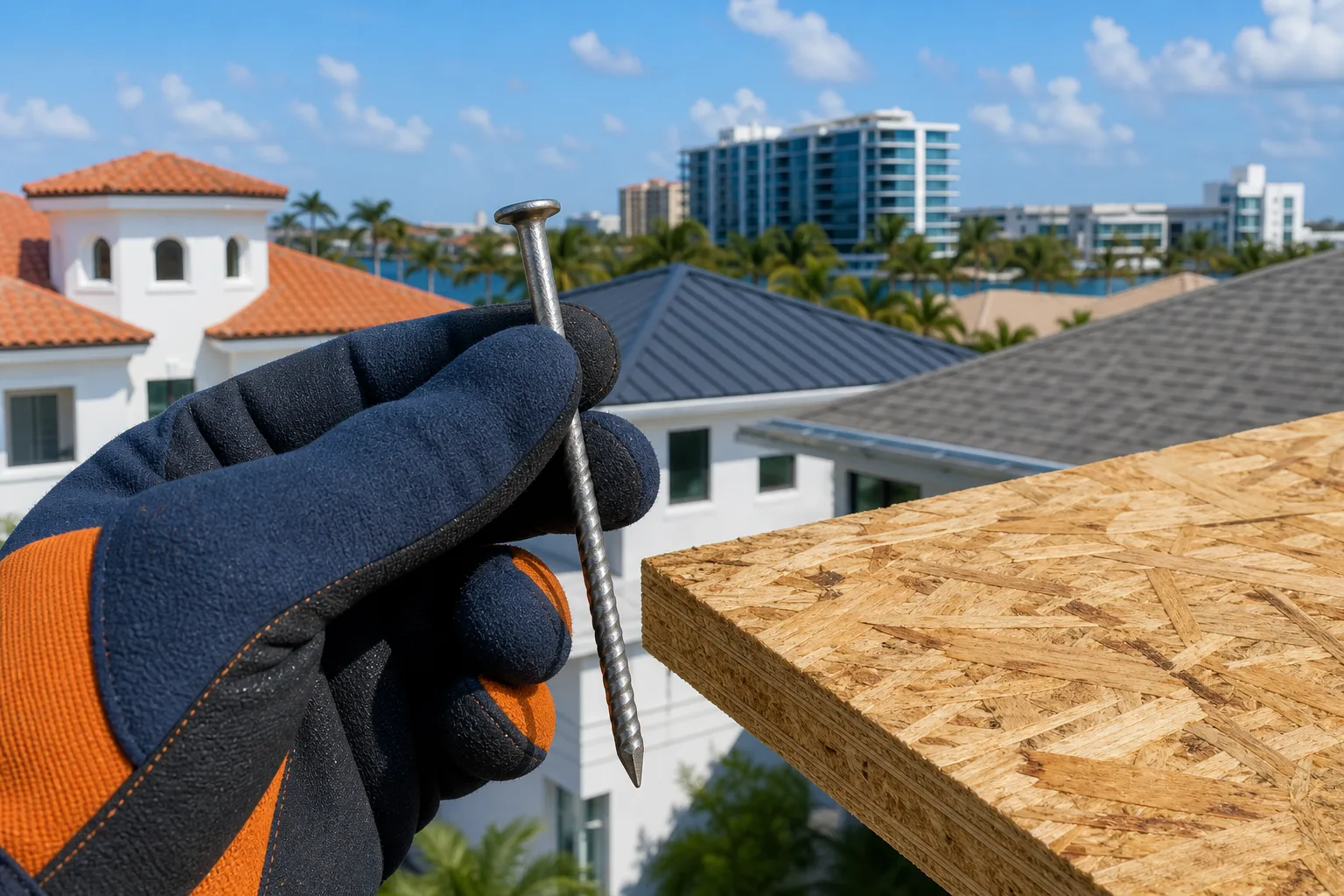
Step 2: Know Why Ring-Shank Nails Are Standard in Florida
Nail type matters as much as length. Smooth-shank nails are cheaper and easier to drive, but they pull out more easily under wind uplift. Ring-shank nails have ridged shanks that grip the wood fibers and resist withdrawal significantly better.
Most shingle manufacturers require ring-shank nails for their wind-rated products. Using smooth-shank nails, even at the correct length, can void the wind warranty on the shingle. If a wind mitigation inspector finds smooth-shank nails during an inspection, your insurance discount for a new roof may be reduced or eliminated.
See how fastener choices connect to hurricane performance in our related post on roof fastener patterns and hurricane resistance.
Step 3: Match Nail Length to Your Actual Deck Thickness
This is where errors happen. Deck thickness is not always uniform, especially on older Florida homes where the original sheathing may have been replaced in sections, or where a re-roof was done over existing decking.
Here is the decision sequence:
- Confirm the actual deck thickness (the permit drawings or a contractor's probe can determine this).
- Add the shingle thickness plus any underlayment thickness to the nail travel distance before it reaches the deck.
- Ensure the remaining nail length exceeds 3/4 inch into the deck, or meets the full-penetration requirement if you are in the HVHZ.
- If you are re-roofing over existing felt or a peel-and-stick underlayment, account for that added layer.
A 1-1/4 inch nail is the common minimum. Many Florida roofers default to 1-1/2 inch nails as a margin of safety, particularly on homes with thicker underlayment systems or in windier coastal zones.
Want to know what your roof actually needs? Get a free estimate
Step 4: Verify the Nail Pattern, Not Just the Length
Length alone does not determine wind resistance. The number of nails per shingle and the placement pattern work together with nail length. Florida code and manufacturer specs typically require four nails per standard three-tab or architectural shingle, placed in the nailing zone printed on the shingle face.
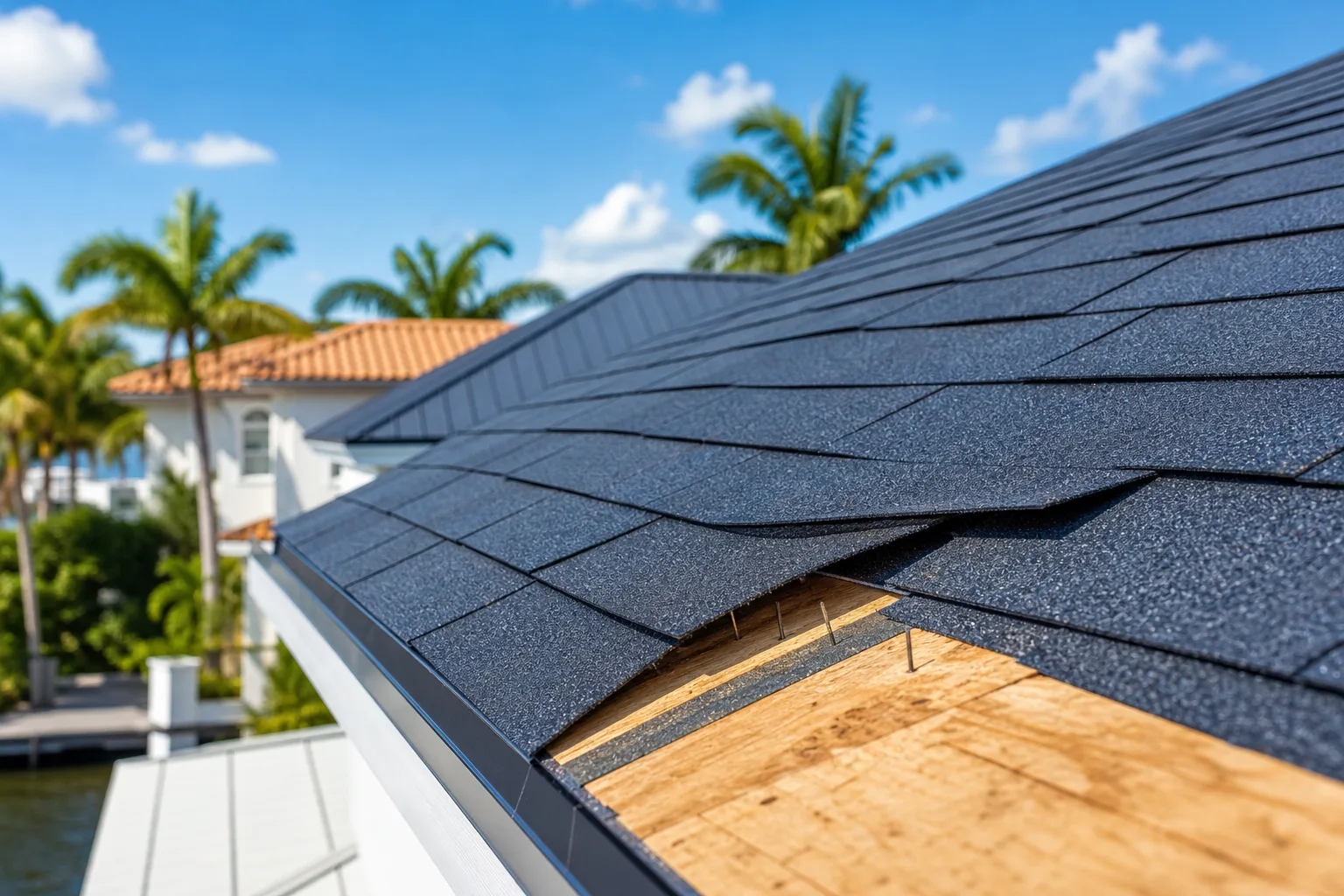
Nailing above the zone (called "high nailing") reduces the effective hold even if the nail length is correct. The nail must engage the shingle below it in the overlap, and high nailing skips that connection. During an inspection, a roofer or wind mitigation inspector checks for this visually or by lifting a shingle tab.
Shingle roofing services at Millennium Makeover follow manufacturer nailing specs and Florida code requirements on every installation.
Step 5: Check This on Any Bid or Inspection Report
When you receive a roofing bid or review a wind mitigation report, look for these specifics:
- Nail length called out by measurement (not just "roofing nails")
- Nail type specified as ring-shank or screw-shank
- Number of nails per shingle (four is the minimum for most wind zones)
- Deck thickness noted or assumed
- Reference to the applicable code or Miami-Dade Notice of Acceptance (NOA) if in the HVHZ
If a bid does not list fastener specs, ask for them in writing before signing. A contractor who knows their work will not hesitate to provide this.
For a transparent estimate that includes material specs, use our free instant estimate tool or request a quote.
Common Mistakes
Using the wrong nail for the deck thickness. A 1-inch nail on a 1/2-inch deck after passing through two layers of underlayment may not meet the penetration minimum. Always do the math.
Assuming smooth-shank nails are acceptable. Some crews carry smooth-shank nails as backup and use them when ring-shank stock runs low. This is a warranty violation on most shingle products.
Ignoring county-specific amendments. HVHZ requirements are stricter than the base Florida Building Code. Homes in Miami-Dade and Broward need products with a valid NOA, which specifies the exact fastener required.
Skipping nail zone placement. Even perfectly long ring-shank nails driven above the nailing zone reduce uplift resistance. Placement and length both matter.
Not verifying fastener specs after the job. A wind mitigation inspection done after re-roofing is the best way to confirm the installation qualifies for the insurance credit you expected. If your contractor cannot tell you what fasteners were used, that is a problem.
If you are in South Florida and have concerns about a recent installation, a roof repair consultation can include a fastener check.
Bottom Line
Nail length on a Florida shingle roof is a code-driven, warranty-driven, and wind-resistance-driven decision. Most South Florida roofers use 1-1/4 to 1-1/2 inch ring-shank nails to satisfy penetration requirements and manufacturer specs. The right number depends on your deck thickness, underlayment system, and county. When reviewing any bid or report, ask for fastener specs in writing. If you are in a hurricane-prone coastal area around Boynton Beach, Delray Beach, or West Palm Beach, verifying these details is worth the extra ten minutes.
For residential roofing questions or a no-pressure estimate, reach out through our contact page or use the instant estimate tool.
Want to know what your roof actually needs?
Millennium Makeover has been roofing South Florida homes and businesses since 2005. Get a straight, no-pressure estimate from a licensed local crew (CCC1326328).
Frequently asked questions
What happens if the wrong nail length was used on my Florida shingle roof?
If nails do not achieve the required penetration depth, the roof may not meet its rated wind resistance and the shingle warranty could be voided. A wind mitigation inspection can reveal this, and in some cases a re-nail of the deck is possible without a full replacement.
Do all Florida counties require the same nail length for shingles?
No. The base Florida Building Code sets a minimum, but Miami-Dade and Broward counties fall under the High-Velocity Hurricane Zone and require products with a Notice of Acceptance (NOA) that specifies exact fasteners. Palm Beach County follows the standard code but has its own wind speed design requirements that affect product selection.
Can a homeowner check nail length after a roof is installed?
Not easily. Once shingles are down, nail length cannot be confirmed without removing a shingle. A licensed wind mitigation inspector can sometimes assess this by probing or by reviewing the permit and product NOA, but physical verification requires lifting a shingle tab carefully.
Does nail length affect my homeowner's insurance premium in Florida?
Indirectly, yes. Wind mitigation credits in Florida are tied to the roof's construction features, including fastener type and pattern. If ring-shank nails are confirmed and the nailing pattern meets code, you may qualify for an insurance discount on the wind portion of your premium.