Storm-Chaser Roofing Companies: How to Spot and Avoid Them
In this article
TL;DR: Storm-chaser roofing companies follow hurricanes into South Florida, pressure homeowners into signing contracts, and often leave shoddy work behind. Knowing how to verify a Florida license, read an Assignment of Benefits clause, and time your hire correctly can save you from a nightmare claim and a roof that fails at the next storm.
What you need
Before you start vetting any post-storm contractor, gather these items. Having them ready makes every step faster.
- Your current homeowner's insurance policy declarations page
- A copy of any contract or door-hanger left by a contractor (do not sign anything yet)
- Access to the Florida DBPR license lookup (free, takes 30 seconds)
- The Palm Beach County Building Department contact or permit portal
- A baseline understanding of what Florida Statute 489 requires of roofing contractors
- Photos of your roof taken before any crew sets foot on it
If a contractor showed up uninvited within 48 hours of a storm and is already pressuring you, treat every step below as urgent.
Step 1: Understand what a storm chaser actually is
A storm chaser is not a specific company type. It is a business model. Crews, sometimes entire operations based in Texas, Georgia, or the Carolinas, track weather events and mobilize into affected areas within hours. They canvas neighborhoods, knock on doors, and offer free inspections. Some are genuinely trying to help. Many are not.
The business model relies on volume and speed. They sign as many contracts as possible, pull minimal permits or none at all, subcontract work to whoever is available locally, collect payment from insurers through an Assignment of Benefits arrangement, and move on before problems surface.
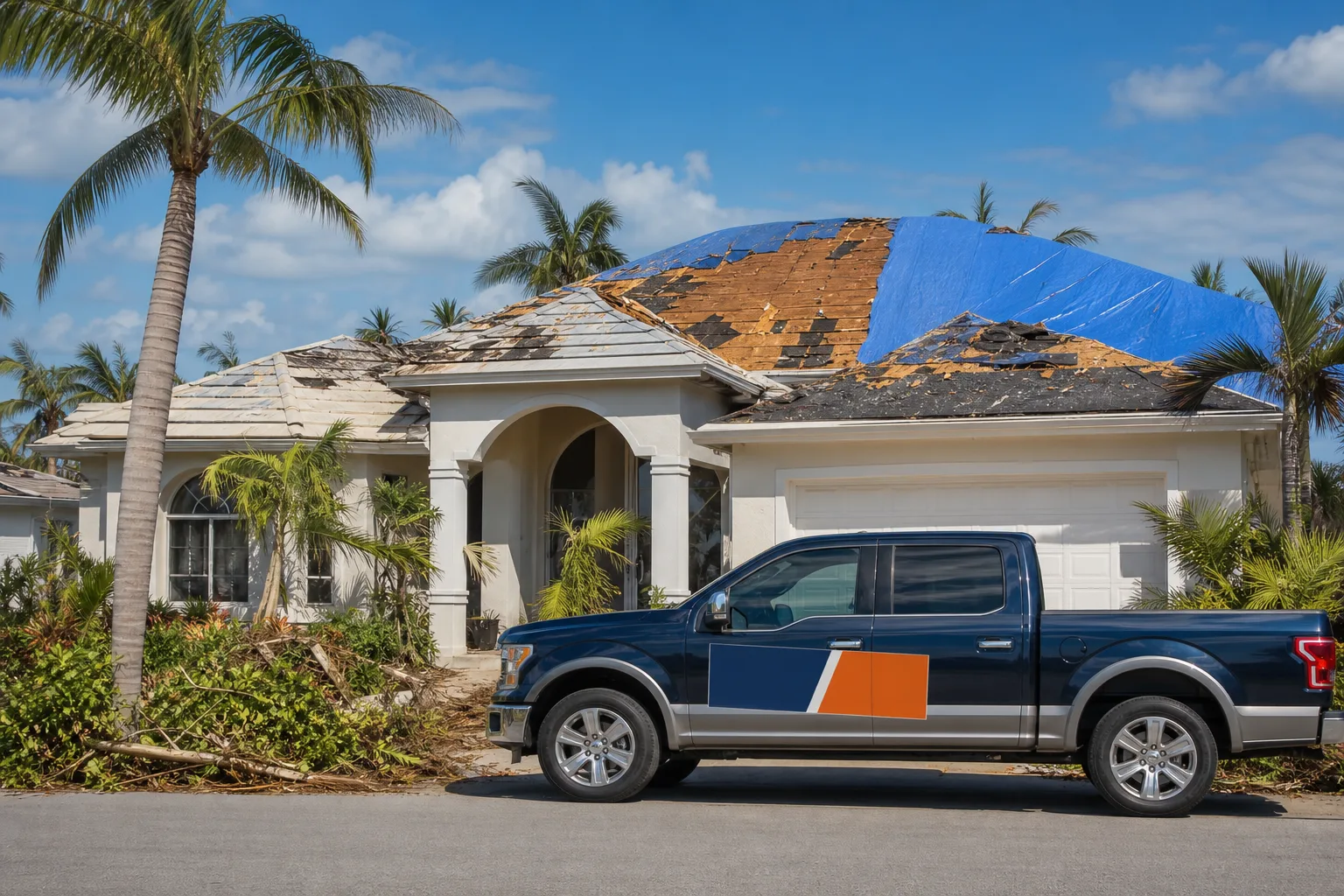
In South Florida, this plays out every active hurricane season. After Ian, Irma, and every named storm that grazed Palm Beach County, the same pattern repeated. Out-of-state trucks with magnetic logos. Crews who do not know Florida's wind load and building code requirements. Permits that were never pulled. Roofs that failed the next season.
The Florida Building Code 2025/2026 reroofing requirements exist precisely because South Florida has unique wind load standards. A crew that installed roofs in Tennessee last month does not automatically know how to meet Miami-Dade NOA product approval requirements or the specific fastener patterns required under Palm Beach County's wind zone designations.
Step 2: Verify the Florida contractor license before any conversation goes further
Florida requires every roofing contractor to hold a state-issued Certified Roofing Contractor license, designated CCC followed by seven digits. That license is issued by the Florida Department of Business and Professional Regulation.
Here is the exact process:
- Ask the salesperson or crew for the license number in writing. A legitimate contractor will hand it to you without hesitation.
- Go to the DBPR license search, select "Contractor," and enter the number.
- Confirm the license is "Current, Active." Check that the name on the license matches the company name on the contract.
- Confirm the license holder carries active general liability and workers' compensation insurance. Ask for certificates of insurance naming you as the certificate holder.
For reference, Millennium Makeover holds license CCC1326328, issued in Florida and active since 2005. When you check it, the status, the name, and the insurance all line up. That is the baseline you should expect from any contractor you consider.
If the salesperson cannot produce a license number, says it is "in process," or offers a license from another state as though it applies in Florida, end the conversation.
Step 3: Read the contract for Assignment of Benefits language before signing
Assignment of Benefits, or AOB, is a clause that transfers your right to file and negotiate an insurance claim directly to the contractor. Florida significantly restricted AOB through legislation passed in 2022 and 2023, but some contractors still use similar language under different names, such as a "direction to pay" or "authorization to collect."
The problem is not that these clauses are always fraudulent. The problem is that once you sign, you lose direct control of your own claim. The contractor communicates with your insurer. You get billed for whatever scope the contractor negotiated, and if there is a dispute, you are now a third party to a contract between your roofer and your insurer.
After a major storm, read every line before you sign. If you see language that assigns your insurance benefits or authorizes the contractor to negotiate directly with your insurer on your behalf, pause. Talk to your insurance company first. Understand what the 2026 changes to storm damage roof claims mean for your specific policy.
A contractor who pushes you to sign immediately, especially while standing on your doorstep with a clipboard, is using pressure tactics. A legitimate contractor will give you time to review the contract.
Is your roof ready for hurricane season? Visit the Storm Center
Step 4: Check for a local physical address and permit history
Anyone can rent a temporary office space or set up a P.O. box after a storm. Press harder.
Ask:
- Where is your permanent office located?
- Can I see examples of permitted roofing work you have completed in Palm Beach County?
- Who will be the licensed contractor of record on the permit for my job?
Every roofing job in Palm Beach County that involves more than minor repair requires a permit. The permit must be pulled by, or under the supervision of, the licensed contractor. If the crew tells you permits are not necessary, or that they will "handle it," get specifics. You can verify permit activity through the Palm Beach County Building Division portal.
A contractor with no local permit history in Palm Beach, Broward, or Miami-Dade counties is almost certainly operating in your neighborhood for the first time. That is not automatically disqualifying, but it raises the question: who do you call when the leak shows up eight months from now?
For comparison, our project gallery shows completed local work. A contractor with a real track record in the area will be able to show you something equivalent.
Step 5: Get an independent inspection before committing to any scope of work
Storm chasers often tell you your roof is totaled when it may only need repairs. They also sometimes undersell damage to keep the initial price low and then request supplemental payments from your insurer later.
Before you agree to any scope, whether it is a full residential roof replacement or targeted storm repairs, get an independent assessment. Our Hurricane Storm Center is set up specifically for post-storm situations in Palm Beach County. We can tell you what actually needs to be done, what your insurer is likely to cover, and what the code requires for the repair to pass final inspection.
If a storm chaser says your roof needs full replacement and a local licensed contractor says it needs targeted repair, that discrepancy is worth investigating before you file anything with your insurer.
Step 6: Time your decision correctly
This is one area where homeowners get pushed into bad choices. After a storm, the adrenaline is still running. There is visible damage, maybe a tarp on the roof, and a contractor is saying the price goes up tomorrow.
Here is the reality of post-storm timing in South Florida:
If you have active water intrusion, you need emergency tarp service quickly, and that is a reasonable thing to authorize fast. But a full roof replacement is not an emergency in the same way. You have time to file the initial claim without penalty, though the exact deadline depends on your policy and when it was issued, so check your declarations page before assuming. Use that time to verify licenses, read contracts, and get competing estimates.
The urgency a storm chaser creates is often manufactured. The window to make a good decision is wider than they want you to believe.
If you want to get ahead of the next season rather than react after the fact, the best time to assess your roof is before June 1. Our post on getting hurricane-ready in 2026 walks through the pre-season inspection timeline that gives you the most options and the most leverage.
Common mistakes
Signing before verifying. The clipboard pressure works because people sign before checking the license. Do not sign anything, even a "free inspection authorization," until you have verified the license on DBPR.
Assuming state licensing equals local code knowledge. A Florida CCC license allows a contractor to work statewide, but South Florida has demanding wind load and building code requirements that vary by county. Ask directly whether the contractor has worked in South Florida wind zone conditions before.
Letting the contractor file the claim without involving your insurer first. Call your insurance company before any contractor files on your behalf. Understand your policy's requirements for contractor authorization.
Skipping the permit. If a contractor tells you a repair or replacement does not need a permit, verify that independently with the county. An unpermitted roof can affect your insurance coverage and complicate a future home sale.
Choosing based on price alone. A low bid from a storm chaser may reflect a crew that is cutting corners on underlayment, fastener patterns, or flashing details. Knowing what drives roofing material costs in South Florida helps you evaluate whether a bid is realistically priced.
Bottom line
Storm chasers are a predictable consequence of every hurricane season in South Florida. They are not all fraudulent, but the business model they operate under creates conditions where shortcuts happen and accountability disappears. Your protection is practical and specific: verify the Florida license on DBPR, read every contract line before signing, confirm a permit will be pulled, and take enough time to get at least one estimate from a contractor with a verifiable local track record.
If you are working through storm damage right now, or want a pre-season assessment before the next one, you can request a quote or get an instant estimate from our team. We have been licensed and locally based in South Florida since 2005, and we will still be here when you need a warranty call.
Is your roof ready for hurricane season?
A pre-season inspection is the cheapest insurance you'll ever buy. Our Storm Center has you covered before and after the storm.
Frequently asked questions
How do I verify a Florida roofing contractor's license?
Go to the Florida DBPR license search at myfloridalicense.com and search under the Contractor category using the CCC license number the contractor provides. Confirm the status reads Current Active and that the name on the license matches the company name on your contract. Also ask for certificates of general liability and workers' compensation insurance.
Is it illegal to work as a roofing contractor in Florida without a state license?
Yes. Florida Statute 489 requires any person or company performing roofing work for compensation to hold a valid Certified Roofing Contractor license issued by the DBPR. Working without one carries criminal penalties under Florida law, though the specific charges and penalty tiers depend on the circumstances and prior violations, consult the statute or a legal professional for details. Homeowners who knowingly hire an unlicensed contractor may also lose certain insurance protections.
What is Assignment of Benefits and why should I be careful about it?
Assignment of Benefits is a contract clause that transfers your right to file and manage an insurance claim from you to the contractor. Once signed, the contractor negotiates directly with your insurer without your direct involvement, and disputes over scope or payment become complicated. Florida passed significant AOB reform through legislation in 2022 and 2023, but similar language still appears in some contracts under different terms, so read carefully before signing anything.
Do I need a permit for roof repairs or replacement in Palm Beach County?
Most roofing work in Palm Beach County beyond minor maintenance requires a permit, including full replacements and significant repairs. The permit must be pulled by or under the supervision of the licensed contractor of record. An unpermitted roof can void warranty claims, complicate home sales, and in some cases affect your insurance coverage after a future storm.
How long do I have to file a storm damage roof claim in Florida?
The deadline to file an initial claim depends on your policy and when it was issued, Florida law has changed in recent years, and different deadlines may apply to policies issued at different times. Check your declarations page and contact your insurer to confirm your specific filing window. In most cases you have enough time to verify a contractor's license, review contracts, and get multiple estimates before filing. Do not let a contractor's artificial urgency push you into skipping those steps.
What questions should I ask a roofing contractor after a storm before signing anything?
Ask for the Florida CCC license number and verify it on DBPR before the conversation goes further. Ask whether the contractor has completed permitted work in Palm Beach County before, who will be the licensed contractor of record on your permit, and for certificates of liability and workers' comp insurance. If any of those questions produce hesitation or vague answers, that is a meaningful warning sign.