How to Document Roof Damage for an Insurance Claim
In this article
TL;DR: Good documentation starts the moment the storm passes, not when the adjuster calls. Photograph everything, preserve damaged materials, and get a licensed contractor's written assessment before you sign anything. In Florida's insurance climate, a thin file means a thin check.
What You Need Before You Start
Before you climb onto anything or start clicking photos, pull these items together.
- Your current insurance policy. Know your named-storm deductible. In Florida, hurricane deductibles are usually a percentage of your dwelling coverage, not a flat dollar amount. That distinction matters a lot.
- Your roof permit history. Palm Beach County property records show permit dates online. If your roof was permitted and passed final inspection, that is evidence your system met code at installation.
- A baseline inspection report, if you have one. If you had a pre-season inspection done, that report establishes what was pre-existing and what is new storm damage. If you do not have one yet, read up on what happens during a professional roof inspection so you know what to request going forward.
- A safe ladder and a helper. Do not go up alone. South Florida roofs are steep or flat with gravel, both slippery after rain.
- Your phone or camera, fully charged, with location services on. Geotagged photos carry timestamp and GPS data that adjusters can cross-reference.
Step 1: Record Conditions Immediately After the Storm
Time stamps are your first line of defense. Insurance carriers compare your claim date against NOAA storm track data and local weather station logs. The closer your documentation is to the actual event, the harder it is for an adjuster to argue the damage was pre-existing.
As soon as it is safe to go outside, do the following.
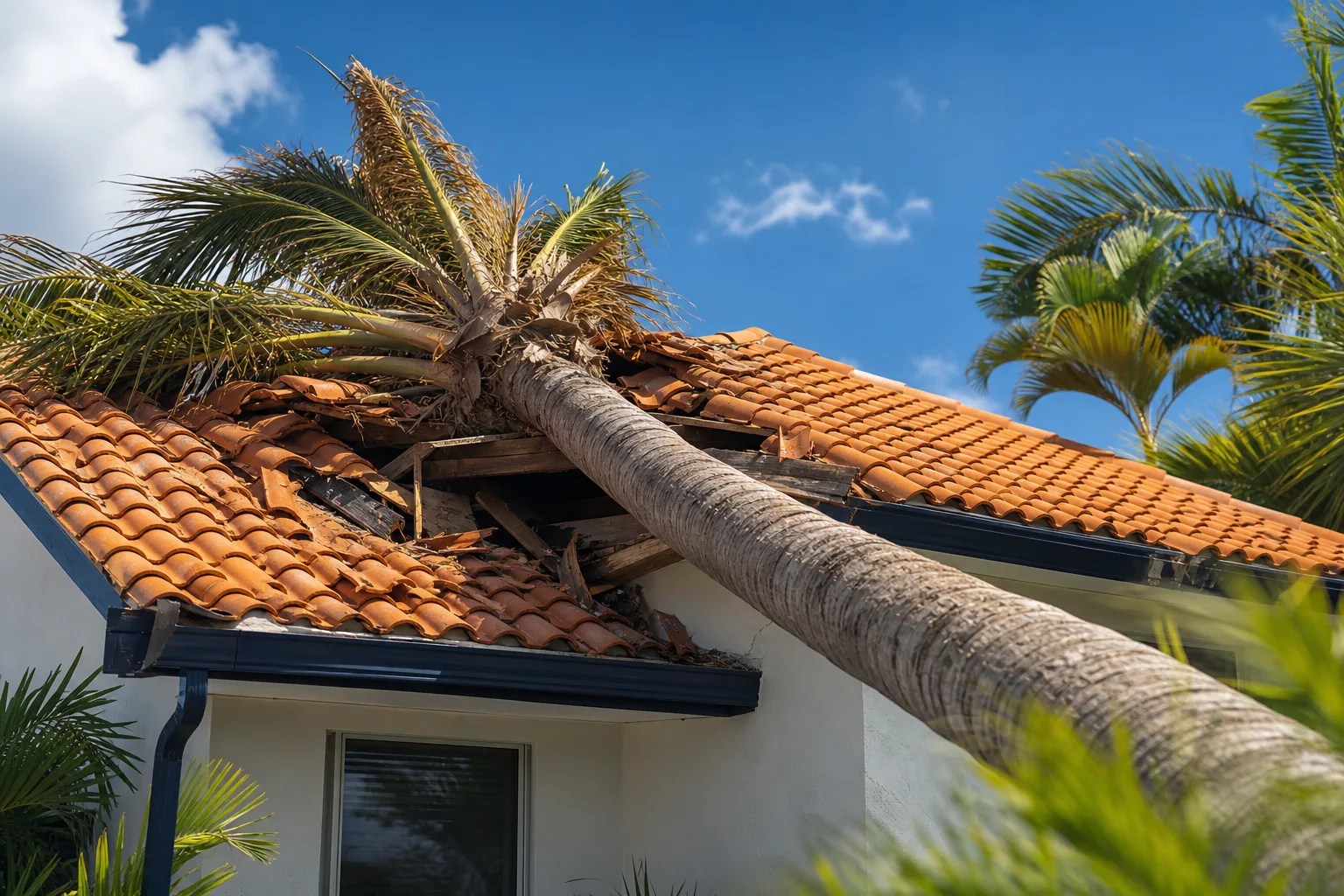
Photograph the whole exterior first. Walk a full loop around the house. Shoot wide angles of each roof face from ground level. Capture fallen debris, downed tree limbs, scattered shingles on the lawn, and any ponding water visible from the edge.
Note the date, time, and storm name or event. If Tropical Storm or Hurricane X passed through, write that down in a notes app or text yourself. The NOAA storm archive and National Hurricane Center records will confirm it later.
Check your gutters and downspouts. Granule accumulation in gutters after a storm is a key indicator of shingle impact damage. Scoop a handful and photograph it next to a ruler if you can. Visit our gutters page to understand how gutter condition factors into overall roof health assessments.
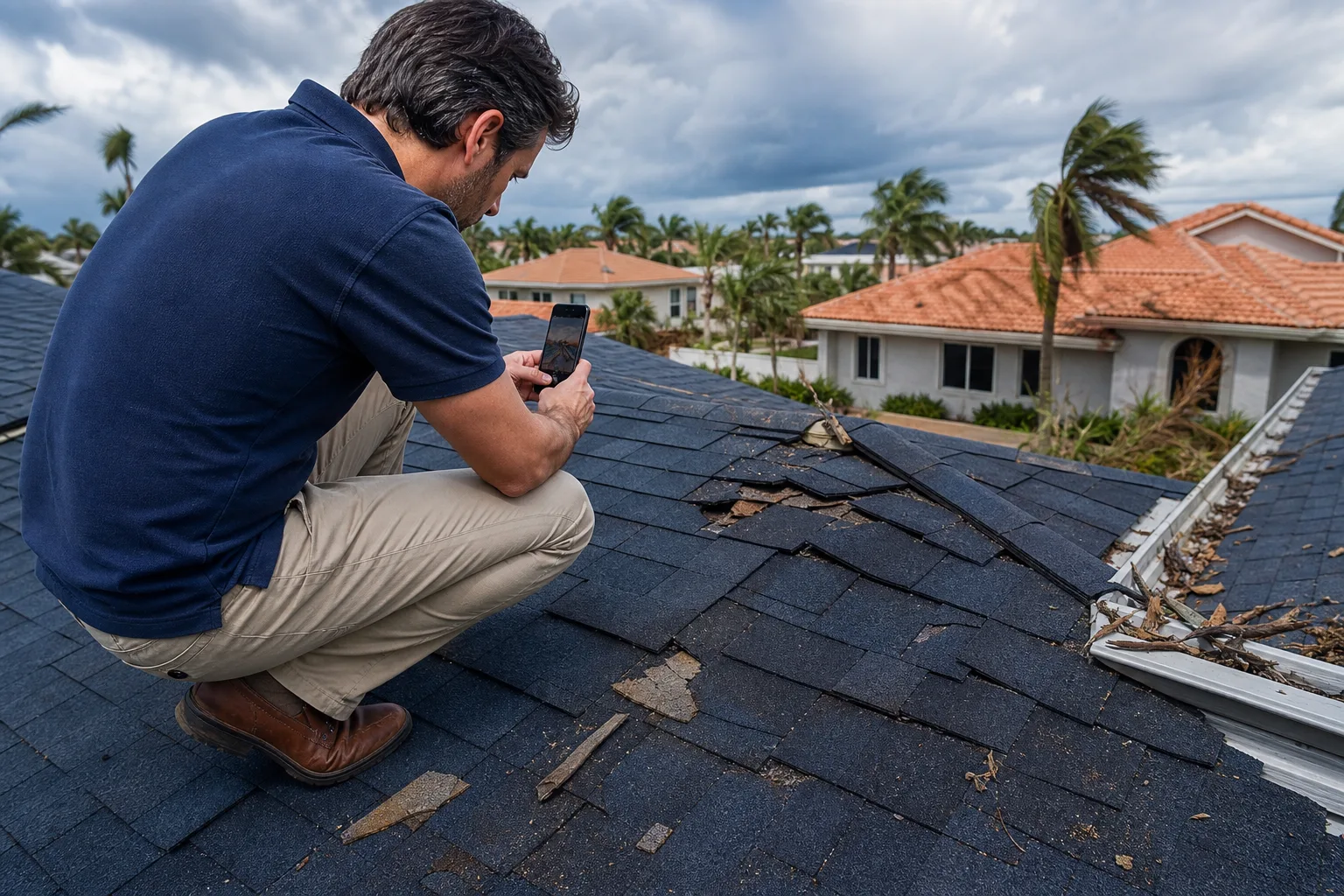
Step 2: Photograph Damage Systematically, Not Randomly
Adjusters see hundreds of claims. Random snapshots of random shingles do not tell a story. Organized photo sets do.
The three-distance rule
For every area of damage, shoot three distances.
- Wide shot. Shows where on the roof the damage sits. Landmarks help: the chimney, the ridge, a dormer.
- Mid shot. Fills the frame with the damage zone. Shows pattern, not just a single shingle.
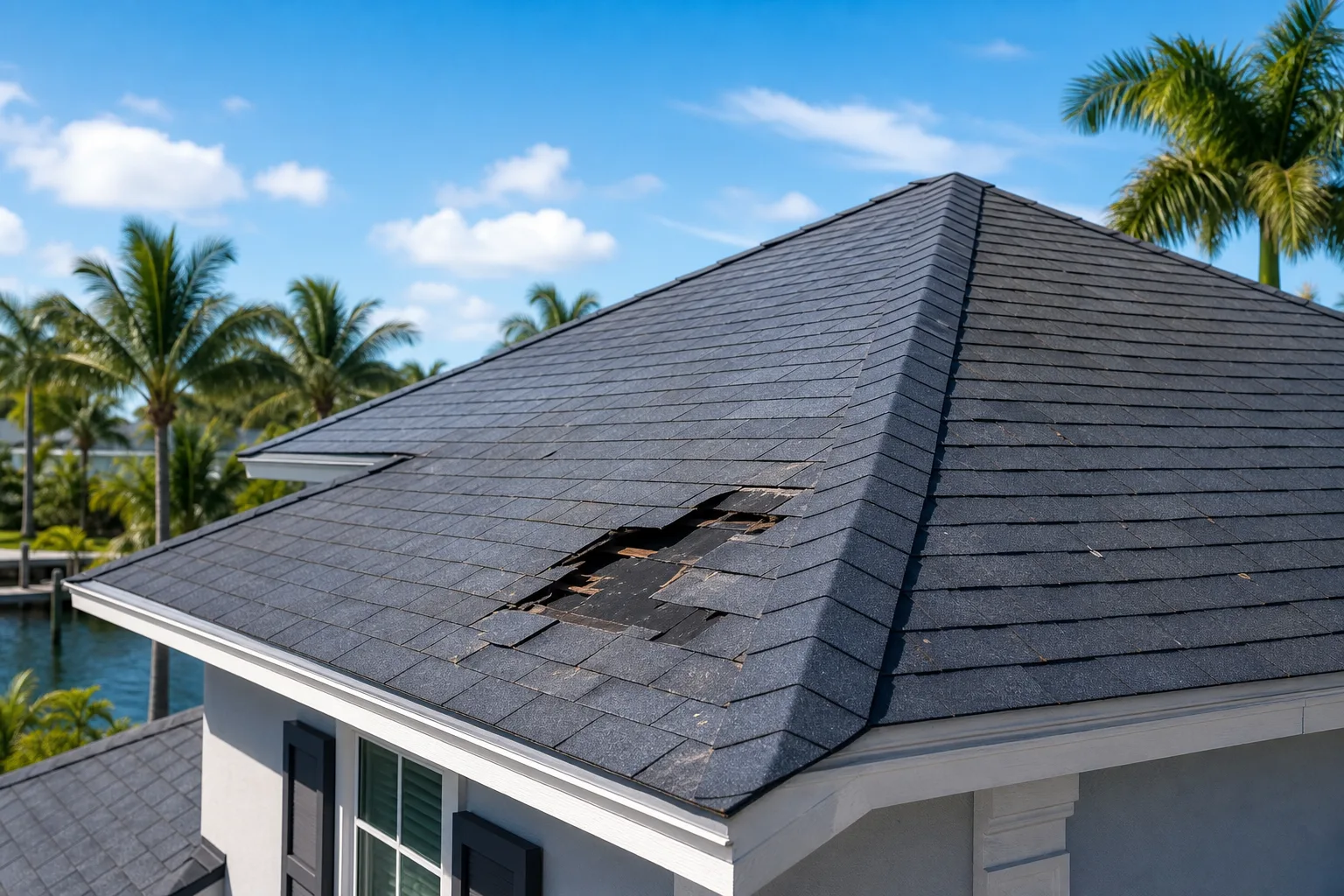
- Close-up. Two to three feet away. Shows bruising on shingles, cracked tile, lifted flashing, puncture holes, or exposed underlayment.
Repeat this sequence for every distinct damage area. If you have impact damage on the front slope and wind uplift on the back slope, those are two separate documentation sets.
Interior damage counts too
If water got in, photograph the ceiling stains, wet insulation in the attic, and any damaged contents. Measure the stain diameter and write it down. Interior water intrusion corroborates exterior damage and strengthens your claim considerably.
Do not discard damaged materials
If shingles blew off, stack them somewhere dry. If a tile cracked, keep the pieces. Physical evidence that an adjuster can inspect in person is worth more than a photo of an empty patch.
Step 3: Get a Licensed Contractor's Written Assessment
This step is where South Florida homeowners most often leave money on the table.
Your insurance adjuster works for the insurance company. A licensed roofing contractor who writes you a detailed damage assessment works from your interests. The two reports should agree on the facts; when they do not, having your own professional documentation gives you standing to dispute.
Ask for a written report that includes:
- The contractor's license number (in Florida, roofing contractors carry a CCC prefix license under Chapter 489)
- Itemized list of damaged components: field shingles, ridge caps, hip caps, flashings, underlayment, decking, fascia
- Measurements in squares (one square equals 100 square feet)
- Whether damage meets the Florida Building Code threshold that triggers full replacement versus repair
- Photos taken by the contractor, which become part of the file
Florida's 25 percent rule under the Florida Building Code provisions governing existing buildings is important here. If more than 25 percent of the roof area is damaged, code generally requires a full replacement rather than spot repairs. That distinction directly affects claim value. A contractor who knows local code will flag this in their report. You can learn more about how code and insurance intersect in our post on how a new roof affects your home insurance in Florida.
If you need a contractor who knows this territory, start with a free instant estimate or request a quote from our team.
Is your roof ready for hurricane season? Visit the Storm Center
Step 4: File Promptly and Track Every Communication
Florida Statute 627.70132 governs hurricane claim deadlines, but Florida's claim-filing laws have been actively amended in recent years, verify the current deadline that applies to your specific storm date and claim type with your insurer or a licensed public adjuster before relying on any general timeframe. That said, do not wait. Carriers are slower when storm volume is high, and a late file gives them an easy objection.
What to submit with your initial claim:
- All geotagged photos organized by roof section
- The licensed contractor's written assessment
- Any existing inspection reports or prior repair invoices
- Receipts for emergency tarping or temporary repairs (keep these, they are reimbursable under most policies)
Track every conversation. When you call your carrier, note the date, time, rep name, and what was said. Follow up phone calls with a brief email summarizing what was discussed. That paper trail matters if the claim gets disputed.
Do not sign a release or accept a final settlement until you are confident the payout covers the actual scope of work. You can always negotiate, especially if you have a competing contractor estimate backed by code requirements. Our Storm Center has additional resources for navigating the post-storm process.
Step 5: Respond to the Adjuster's Visit Strategically
When the adjuster schedules their inspection, have your contractor or a qualified representative present if at all possible. This is not adversarial; it is practical. Two sets of eyes catch more, and your contractor can walk the adjuster through their findings directly.
Bring printed copies of your photo documentation and the contractor's written report. Walk the adjuster through the same three-distance sequences you photographed. Point out the impact patterns, the granule loss, the lifted flashing.
If the adjuster's scope comes back lower than the contractor's estimate, you have options. Request a re-inspection, file a supplemental claim, or invoke the appraisal clause in your policy. Florida's 2023 reforms under SB 2-A (effective January 1, 2023) included material restrictions on appraisal rights and assignment of benefits, among other significant changes, read your policy language carefully and consult a public adjuster or attorney to understand how these reforms affect your specific situation.
Common Mistakes That Hurt Claims
Waiting too long to document. Every day of South Florida sun and afternoon rain after a storm makes it harder to prove what was caused by the event versus what degraded afterward.
Letting a contractor work before the adjuster inspects. Unless there is active water intrusion requiring emergency tarping, let the adjuster see the raw damage first. Document everything before any repair work starts.
Hiring an unlicensed contractor. If a contractor who is not licensed in Florida produces your damage report, carriers will discount it or ignore it entirely. Verify the CCC license at the Florida DBPR website. Our blog on how to choose a roofing contractor in South Florida covers what to check.
Not photographing the attic. Many adjusters underestimate interior storm damage because no one showed it to them. Decking delamination, wet insulation, and rafter damage are real and costly. Photograph the attic before and after every significant storm.
Accepting the first offer without review. Insurance carriers in Florida are under financial pressure. Initial settlements sometimes undercount labor costs, material quantities, or code-upgrade requirements. Compare the settlement against your contractor's itemized estimate line by line.
Confusing storm damage with wear. Adjusters are trained to identify pre-existing wear and deny coverage for it. A good contractor's report distinguishes clearly between storm-caused damage and age-related deterioration. If your roof already had issues, see our guide on roof repair vs. replacement in South Florida to understand what category your situation likely falls into.
Bottom Line
Documenting roof damage for an insurance claim in South Florida is a skill, not luck. The homeowners who get fair settlements are the ones who move fast, photograph systematically, get licensed contractor reports in writing, and track every step of the process.
If a storm has already moved through your area, do not wait for the adjuster to set the narrative. Get your documentation together now. If you want a licensed contractor to walk the roof with you and produce a written assessment, our roof repair team is ready, and you can reach us through the contact page or get started with a free instant estimate.
Is your roof ready for hurricane season?
A pre-season inspection is the cheapest insurance you'll ever buy. Our Storm Center has you covered before and after the storm.
Frequently asked questions
How soon after a storm should I document roof damage?
As soon as it is safe to go outside, ideally within hours of the storm passing. Florida's post-storm humidity and afternoon rain cycles can obscure fresh damage quickly. Geotagged timestamps also help carriers confirm your documentation aligns with the actual weather event.
Does my insurance company require a licensed contractor's report?
Most Florida carriers do not require it, but having one dramatically strengthens your claim. A licensed contractor's written assessment, including their CCC license number and itemized damage list, gives you a professional counterpoint if the adjuster's scope comes in lower than expected.
Can I make temporary repairs before the adjuster visits?
Yes, and you should if there is active water intrusion. Emergency tarping and board-up costs are reimbursable under most Florida homeowners policies. Document everything before and after the temporary repair, keep all receipts, and notify your carrier before starting the work when possible.
What is the 25 percent rule and why does it matter for my claim?
Florida Building Code provisions governing existing buildings generally require a full roof replacement when more than 25 percent of the roof area is damaged or replaced. If your storm damage crosses that threshold, your claim should reflect full replacement costs rather than patch repairs. A licensed contractor familiar with local code should note this explicitly in their assessment.
How long do I have to file a hurricane roof damage claim in Florida?
Florida Statute 627.70132 governs hurricane claim deadlines, but Florida's claim-filing laws have been actively amended in recent years, verify the current deadline that applies to your specific storm date and claim type with your insurer or a licensed public adjuster before relying on any general timeframe. Filing sooner is always better. High storm volume slows carrier response times, and earlier documentation is harder to dispute.
What if the insurance adjuster's estimate is lower than the contractor's estimate?
You can request a re-inspection, file a supplemental claim, or invoke the appraisal clause in your policy. Be aware that Florida's 2023 reforms under SB 2-A included material restrictions on appraisal rights and assignment of benefits, review your specific policy language and consult a public adjuster or attorney to understand your options. Having a detailed written report from a licensed contractor gives you standing to challenge a low settlement. Compare the adjuster's scope line by line against the contractor's itemized estimate before accepting any final offer.