How to Tell If a Roof Leak Is Coming From a Wall or the Roof
In this article
TL;DR: Water inside your home can come from several directions, and the ceiling stain you see is rarely directly below the entry point. Eliminate wall and window sources first, then trace the water path upward through the attic. Getting the diagnosis right saves you from paying for the wrong repair.
What You Need
- A flashlight and a phone or camera for photos
- Safe attic access (do not enter if you smell mold or see sagging drywall)
- A garden hose with a helper if you plan to do a controlled water test
- Basic knowledge of what is on your exterior walls: windows, stucco, siding, or coquina
- A notepad or your phone to document when stains appeared relative to rain events
You do not need to get on the roof yourself. In South Florida, roofs can be steep, hot, and slippery. Leave the high work to a licensed contractor.
Step 1: Note When and Where the Stain Appears
Timing is the most underused diagnostic tool homeowners have. Ask yourself: does the stain show up only during or right after heavy rain? Or does it appear during periods of high humidity, even without rain?
Stain appears only during rain: This points toward an active penetration, either through the roof, a wall, or a window opening. You have a path that water is exploiting under pressure.
Stain appears during humidity or dew cycles, not rain: This is more likely condensation from poor attic ventilation or a duct leak, not a roof or wall breach at all. South Florida's summer humidity is brutal, and poorly ventilated attics can drip water onto the ceiling below without a single drop entering from outside.
Stain grows slowly over weeks: This can suggest a very slow roof leak, a failing pipe boot, or a compromised wall cap flashing. It rarely points to a dramatic roof failure.
Write down the first date you noticed the stain and the last major rain event before that date. That timeline matters when you talk to a contractor or file an insurance claim.
Step 2: Identify the Stain's Location on Your Floor Plan
Stand in the room and look at where the stain sits relative to the nearest exterior wall.
Stain is within 18 to 24 inches of an exterior wall: Wall infiltration becomes a real suspect. In South Florida, stucco cracks, failed window flanges, and deteriorated caulk around frames are extremely common water entry points, especially after a named storm or even a sustained wind-driven rain event.
Stain is in the middle of a room, away from walls: This almost always traces back up to the roof plane or a roof penetration directly above. Think pipe boots, skylights, or flashing. Our post on finding a roof leak source around a skylight covers that specific scenario in detail.
Stain runs along a ceiling-wall joint: This is tricky. It could be a wall leak running sideways along framing, or it could be a roof leak that is tracking along a rafter or truss and exiting at the wall-ceiling connection.
Step 3: Check the Attic Before You Do Anything Else
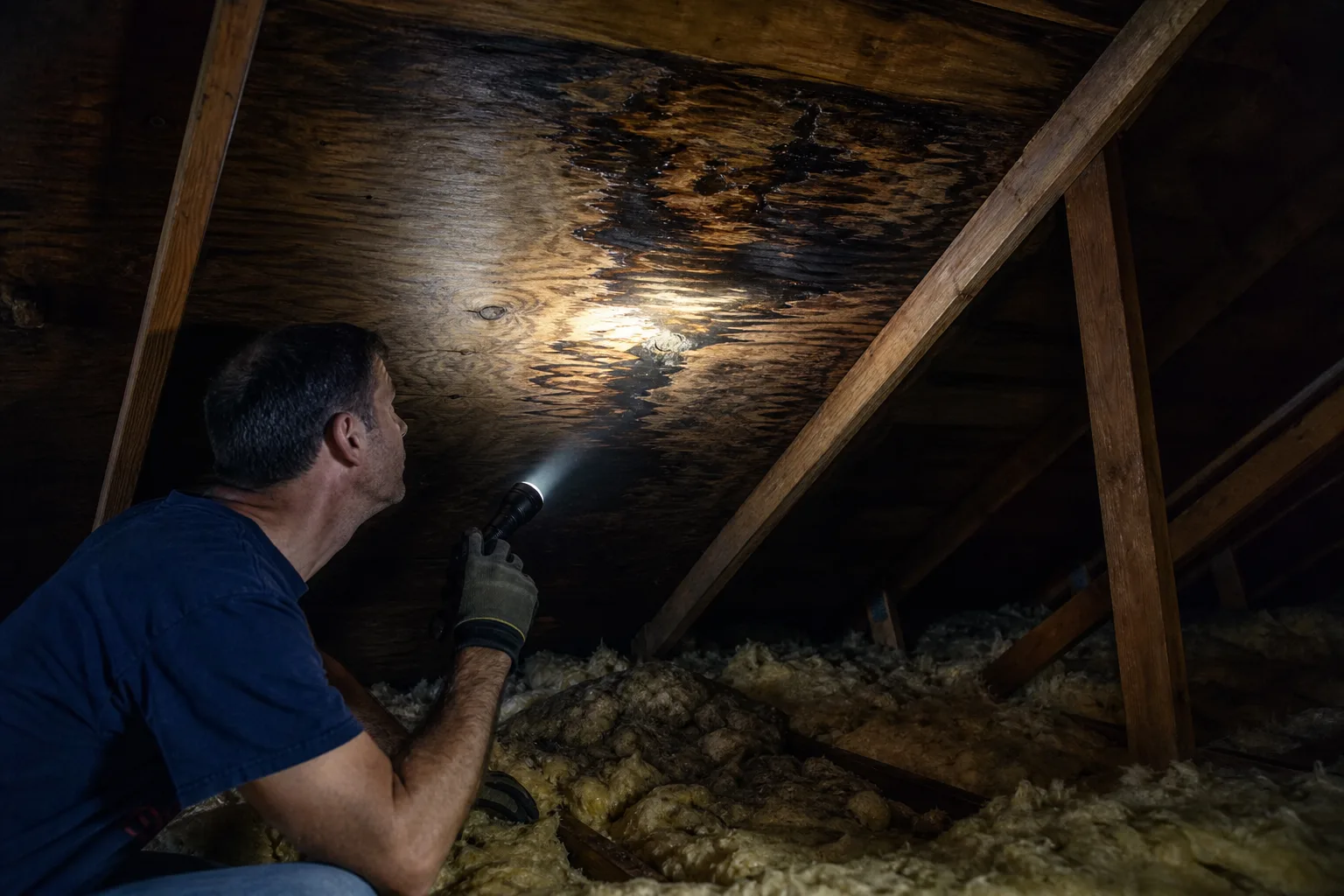
If you have attic access, this step can cut your diagnosis time in half. On a clear day, go into the attic with a flashlight and look for the following:
- Wet or stained roof decking: Dark streaks or soft spots in the plywood indicate water has breached the roof surface and run across the deck. The entry point is almost always uphill from where the staining is worst.
- Wet insulation: Insulation that is clumped, compressed, or discolored has absorbed water. Follow the trail toward the eave or the ridge.
- Light coming through the deck: In a dark attic, small pinpoints of daylight can reveal cracks or gaps. This is a roof problem.
- Wet or stained wall sheathing near the eave: If the wet area is on the vertical sheathing near the exterior wall rather than on the horizontal deck, wall infiltration is more likely.
The attic is genuinely one of the best starting points for any leak investigation. Once you have attic photos, a contractor can make a much faster and more accurate call.
Spotted a leak or missing tiles? Schedule a repair visit
Step 4: Do a Controlled Hose Test if the Source Is Still Unclear
This step requires two people and some patience. Have one person inside watching the stain area while the other works outside with a hose. Start low and work upward.
Test the wall first. Run water slowly over the exterior wall below the window nearest the stain. Hold steady for two to three minutes. If water appears inside, you have a wall or window seal failure, not a roof problem.
Test the window frame next. Slowly run water along the window frame edges and sill. Failed window flanges and dried-out backer rod are very common in South Florida homes built before 2005.
Test the roof last. If wall and window tests come up dry, move to the roof edge and then work uphill across any penetrations, flashing, or valleys. This is where having a second person is critical, because roof leaks can take five to ten minutes to travel down to the stain location inside.
Do not rush this process. Contractors who skip straight to the roof without ruling out walls first sometimes miss the actual source entirely.
Step 5: Look at the Exterior Wall for Physical Clues
Step outside and examine the wall surface directly below or beside the stain area.
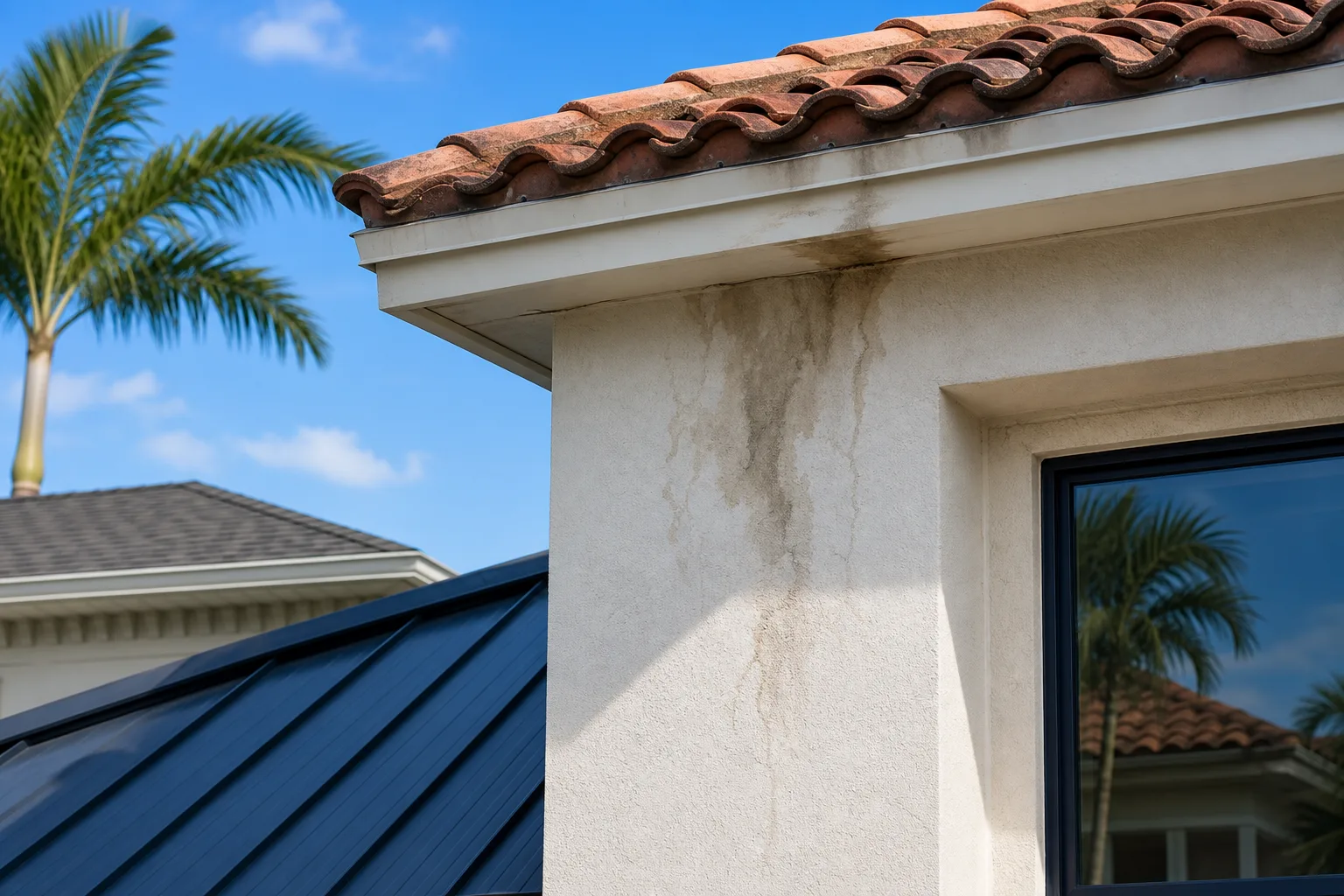
Stucco cracks: Hairline cracks in stucco are cosmetic. Cracks wider than a credit card thickness, especially horizontal or stair-step cracks, can channel water into the wall cavity during wind-driven rain.
Window caulking: Press your finger along the caulk bead around window frames. If it is hard, cracked, or separating from the frame, it is no longer sealing. This is one of the most common non-roof water entry points in South Florida homes.
Rusted or missing weep screed: The weep screed at the base of stucco walls is designed to let trapped moisture escape. If it is clogged or missing, water can wick upward inside the wall assembly.
Flashing at the wall-roof junction: Where your roof meets a vertical wall, there should be step flashing and counter flashing. If you can see this junction from the ground and the metal looks lifted, rusted, or missing, that transition zone is a strong candidate for the leak source. Our article on replacing flashing during a reroof in South Florida explains why that detail gets skipped and what it costs.
Step 6: Call for a Professional Inspection
Once you have done your own documentation, including photos, timing notes, and hose test results, you are in a much stronger position to describe the problem to a contractor.
A licensed roofer should be able to inspect the roof surface, the flashings, the penetrations, and the attic in a single visit and give you a clear diagnosis. If the evidence still points toward the wall or windows, they should tell you that plainly and recommend a stucco or window contractor instead.
For roof-side repairs in South Florida, our repair services page covers what a proper assessment and repair process looks like. If you want a quick starting point, you can also get an instant estimate based on your home's details.
If this inspection follows a storm, document everything with photos before any temporary repairs are made. Florida's insurance claim process requires clear evidence of the original damage, and tarped or patched areas can complicate that. Our Hurricane Storm Center has more guidance on post-storm documentation.
Common Mistakes
Assuming the stain is directly below the leak. Water travels along rafters, insulation, and wall cavities before it shows up on your ceiling. The entry point can be several feet away from the stain.
Blaming the roof before checking the windows. Window and wall failures cause a significant share of interior water damage in South Florida, but homeowners default to calling a roofer first. That is not always wrong, but it can lead to an unnecessary or incomplete repair.
Ignoring a stain because it dried out. Dried stains mean the moisture is still in the wall or ceiling assembly. Mold can begin growing within 48 hours of a wet event in South Florida's climate. A stain that looks old is still worth investigating.
Getting on the roof without proper safety equipment. Tile and metal roofs can be slippery and fragile in spots. Walking a tile roof incorrectly can cause cracked tiles and new leak points. Leave roof access to licensed contractors.
Skipping the attic. Homeowners who go straight from a ceiling stain to a roofing company call without checking the attic often spend money before anyone has actually seen where the water is entering. The attic almost always holds the clearest evidence.
Bottom Line
A ceiling stain is a symptom, not a diagnosis. Before you commit to a roof repair or a wall repair, take twenty minutes to document the stain's location, check your attic, and walk your exterior walls. Ruling out windows and stucco first saves time and money, and it makes any professional inspection go faster.
If the source turns out to be the roof, South Florida has specific requirements for how repairs need to be done and permitted, particularly anything that touches the deck or the flashing systems. Working with a licensed contractor who knows the Florida Building Code protects you on the repair quality side and on the insurance side.
When you are ready to get a professional set of eyes on it, contact our team or request a quote and we will start with an honest assessment of what is actually happening and where the water is actually coming from.
Spotted a leak or missing tiles?
Small problems get expensive fast in the Florida sun. Get it looked at by a local crew before the next storm.
Frequently asked questions
How can I tell if water is coming through my wall or my roof?
Start by checking the stain's location relative to exterior walls and windows, then inspect your attic for wet decking or insulation. A controlled hose test, starting at the wall and working upward to the roof, can help isolate the entry point. Timing also matters: stains that appear only during wind-driven rain often point to wall or window failures, while stains in the center of a room typically trace back to the roof.
Can a ceiling stain be caused by something other than a roof or wall leak?
Yes. In South Florida, attic condensation is a common cause of ceiling moisture, especially in homes with inadequate ventilation or leaking HVAC ducts. If the stain appears during humid periods without rain, or if you see no wet decking in the attic, have your duct work and attic ventilation checked before assuming it is a roof or wall problem.
Why does my ceiling stain appear far from where I think the leak is?
Water follows the path of least resistance. It can travel along rafters, ceiling joists, insulation, or wall framing for several feet before dripping down to a visible spot. This is why the stain on your ceiling may be nowhere near the actual entry point, and why attic inspection is so valuable for tracing the true source.
Should I fix a wall leak or a roof leak first?
Fix whichever is actively letting water in first. If both are compromised, a temporary tarp or sealant can protect the roof while wall or window repairs are scheduled. Do not let either go untreated in South Florida's climate, where mold can begin developing within 48 hours of a wet event.
Do I need a licensed contractor to diagnose a roof leak in Florida?
You are not legally required to hire a licensed contractor just to inspect, but any repair work that involves the roof covering, decking, or flashing typically requires a licensed roofing contractor under Florida law. Using a licensed contractor also matters for insurance claims, since work done by unlicensed individuals can complicate or void a claim.